Protect Your Business From Evolving Cyber Threats
We secure your digital assets with advanced security solutions, continuous monitoring, and expert risk management.
‹ Noobtron TechWork | 6 MONTH PROGRAM ›
Applied Data Science and ML with Specialization in Industrial AI
Specialisation in Predictive Analytics | Industrial Automation | AI Deployment
Inspired from Industry leaders




Industry leaders powering your journey in Applied Data Science & Machine Learning with specialization in Industrial AI.
FUTURE READY
Industry-Ready AI Skills
DURATION
6 months with hands-on projects
CAMPUS
2 days on NoobTron Campus Chennai
LIVE CLASSES
Live classes with 24/7 AI support
FUTURE READY
Industry-Ready AI Skills
DURATION
2 Months With hands On Project
OPTIONAL
2 days on NoobTron Academy Campus, Chennai
FORMATE
Live Classes With 24/7 AI Support
Traditional programs teach algorithms.
We train you to architect Industrial AI systems capable of transforming real-world operations at scale.
From intelligent automation and industrial analytics to autonomous decision systems, this programme is built for future engineers driving the next generation of smart industries.
Applied AI Engineering Framework
Master the complete Industrial AI lifecycle — data acquisition, preprocessing, model engineering, deployment pipelines, intelligent monitoring, and AI-driven operational optimization.
Industrial Intelligence Labs
Train on high-volume industrial datasets, machine telemetry, operational KPIs, IoT sensor streams, and manufacturing intelligence systems designed around real production environments.
Advanced Machine Learning & Deep Learning
Build scalable AI models for predictive maintenance, anomaly detection, process optimization, computer vision inspection, demand forecasting, and autonomous industrial workflows.
Research-Driven Product Development
Learn how research evolves into deployable industrial solutions through AI prototyping, validation pipelines, optimization strategies, and scalable product engineering workflows.







You'll Build Expertise With


INDUSTRIAL AI EXPERIENCES that go beyond classroom projects
Build intelligent automation systems using no-code AI tools, workflow orchestration, API integrations, Edge AI pipelines, and Industry 4.0 technologies capable of solving real industrial challenges.
Develop publication-grade AI projects, industrial case studies, deployment-ready prototypes, and scalable innovation models aligned with enterprise use cases, startup ecosystems, and future AI commercialization opportunities.








A process built for results
Clear milestones, constant communication, and zero hand-waving. Here’s how we get from idea to impact.
STEP 1
Discovery & Success Criteria
We map your current workflows, identify bottlenecks, and define clear metrics for success.
STEP 2
Map Workflows + Data Access
We map your current workflows, identify bottlenecks, and define clear metrics for success.
STEP 3
Build + Test + Security Review
We map your current workflows, identify bottlenecks, and define clear metrics for success.
STEP 4
Launch + Monitor + Iterate
We map your current workflows, identify bottlenecks, and define clear metrics for success.
A step-by-step guide
Clear milestones, constant communication, and zero hand-waving. Here’s how we get from idea to impact.
STEP 1
Modern Cloud Architecture Design with Advanced Azure Cloud Solutions Architect

STEP 2
Submit your application
Fill in your basic details, academic background, and work experience (if any). Upload the required documents and complete your application.
STEP 3
Registration completion
Once your application is reviewed and approved, complete the registration process by making the payment to confirm your seat in the batch.
STEP 4
NoobTron Trainee Offer Letter, be ready with the course schedule
Receive your NoobTron Trainee Offer Letter and get access to the complete course schedule, batch timeline, and onboarding resources. Get ready to begin your learning journey with NoobTron!
Prefer to talk first? +1 (234) 567-890
Explore Directly with Industry Experts
Solve Real Industrial Problems with 100+ Industries
100+ FOUNDERS
Real Industrial Use Cases
Work on live challenges from leading companies.
Expert-Led Brainstorming Sessions
Collaborate with industry experts & peers.
Data-Driven Problem Solving
Apply AI/ML to solve complex industrial problems.
Cross-Industry Exposure
Learn from 100+ industries and diverse use cases.
Real Industrial Use Cases
Work on live challenges from leading companies.
Expert-Led Brainstorming Sessions
Collaborate with industry experts & peers.
Data-Driven Problem Solving
Apply AI/ML to solve complex industrial problems.
Cross-Industry Exposure
Learn from 100+ industries and diverse use cases.
Ananya Mehta
Program Director
, NoobTron Private Limited
Balaji Ramachandran | CEO
Noobtron Private Limited
WHY CHOOSE US
Our programs help learners to use AI more confidently in day-to-day work. We combine education, real examples, and guided practice so people leave with skills they can apply immediately.
Case based Classroom
Meeting-Style Discussion & Debate
Case based Classroom
Meeting-Style Discussion & Debate
Case based Classroom
Meeting-Style Discussion & Debate
Case based Classroom
Meeting-Style Discussion & Debate
Introducing Azure Accelerate for Databases
Modernize your data for AI with experts and investments
Modernize Faster
AI-Ready Data
Built for Trust
Maximize Investments
By Jesse Sullivan, GM, Database Product Marketing
Download the eBook
aka.ms/AzureAccelerateDB
0–3 YEARS
Engineering Graduates, Junior Analysts & AI Enthusiasts
Engineering Graduates, Junior Analysts & AI Enthusiasts
WHAT YOU'LL GAIN
3–7 YEARS
Software Engineers, Data Analysts & Automation Professionals
Software Engineers, Data Analysts & Automation Professionals
WHAT YOU'LL GAIN
7–12 YEARS
AI Engineers, Data Scientists & Industrial Technology Specialists
AI Engineers, Data Scientists & Industrial Technology Specialists
WHAT YOU'LL GAIN
12+ YEARS
Technology Leaders, Innovation Heads & Industrial Strategists
Technology Leaders, Innovation Heads & Industrial Strategists
WHAT YOU'LL GAIN
“I analyze data to find patterns, uncover opportunities, and deliver insights that drive better decisions and real results.”
– Azure Cloud Solutions Architect Learner
Explore Directly with Industry Experts
Who is NoobTron TechWorks For?
100+ FOUNDERS
Future AI Engineers & Industrial Innovators
For students who don’t just want another certification — but want to build intelligent systems, solve industrial challenges, and become part of the next generation of AI-driven engineering talent.
Freshers Ready To Build Real-World AI Solutions
Move beyond classroom theory and work on Industrial AI, Machine Learning, automation systems, predictive analytics, and real-time engineering problems from day one.
Engineers Looking To Become Industry 4.0 Specialists
Learn how to integrate AI with manufacturing, operations, smart systems, industrial automation, and enterprise technologies shaping the future of global industries.
Module 1
- 2–3 hours
Cloud Computing Introduction
- Python Programming Essentials
- Python Environment Setup & IDEs — Anaconda, VSCode, Jupyter Notebook
- Syntax, Variables, Data Types, Typecasting — int, float, str, bool
- Operators, I/O, Conditional Logic — if/elif/else, match-case
- Loops — for, while, list/dict/set comprehensions
- Functions — user-defined, lambda, map(), filter(), reduce()
- String Operations — slicing, formatting, regex basics
- Core Data Structures — List, Tuple, Set, Dictionary: creation and operations
- Matrix Handling and Number System Basics
- Programming Concepts & Best Practices
- Object-Oriented Programming — Classes, Objects, Inheritance, Polymorphism
- Functional Programming Basics — pure functions, immutability
- Exception Handling — try/except/finally, custom error classes
- Modules & Packages — import system, pip, virtual environments
- Intro to Time & Space Complexity — Big-O Notation (O(1), O(n), O(n²))
- Linux for Data Science
- Linux Essentials & File System — root, home, bin, etc. directory structure
- Command Line Navigation — ls, cd, pwd, mkdir, rm, cp, mv
- File Handling, Permissions, Pipes & Redirection — chmod, |, >, >>
- Basic Shell Scripting — variables, loops, conditionals in bash
- SQL Analytics & BigQuery
- Introduction to Databases and Relational Data Models
- Working with Cloud Data — BigQuery Environment Setup, Datasets, Tables
- SQL Essentials — SELECT, WHERE, ORDER BY, LIMIT, DISTINCT
- SQL Functions — Math (ROUND, ABS), String (CONCAT, SUBSTR), Date & Time
- Subqueries and Nested Queries for data filtering
- Aggregate Functions — SUM, COUNT, AVG, MAX, MIN with GROUP BY, HAVING
- Table Joins — INNER, LEFT, RIGHT, FULL OUTER JOIN
- Common Table Expressions (CTEs) for modular query writing
- Window Functions — ROW_NUMBER, RANK, LEAD, LAG for advanced analytics
- Indexes, Views, and Partitioning Concepts
- User-Defined Functions (UDFs) and Query Performance Tuning
- Best Practices for Scalable SQL on Large Datasets in BigQuery
- Tableau — Visual Analytics & Dashboards
- What is Tableau? — Products Overview: Public, Desktop, Online
- Connecting to Data Sources — CSV, Excel, Cloud; Live vs Extract Connections
- Chart Types — Bar, Line, Pie, Histogram, Heat Map, Maps, Scatterplot, Waterfall
- Filters — Dimension, Measure, Extract, Context, Quick Filter Actions
- Basic Calculations, Table Calculations, Quick Table Calculations (Running Total, % of Total)
- LOD (Level of Detail) Expressions — introduction only
- Joins vs Relationships vs Blending, Hierarchies, Groups, Sets, Parameters
- Analytics Pane — Reference Lines, Trend Lines, Forecasting, Clustering
- Dashboard Design — Layouts, Actions, Filters; Publishing to Tableau Public
- Excel for Data Analysis
- Navigating Excel for Data Tasks — Rows, Columns, Cell Formatting
- Formula Basics — SUM, AVERAGE, IF, COUNTIF; Relative vs Absolute References
- Pivot Tables & Pivot Charts — creating, filtering, slicing data
- Charts — Bar, Line, Pie, Scatter for quick visual insights
- Descriptive Stats — MEAN, MEDIAN, MODE, STDEV with Analysis ToolPak
- Conditional Formatting and Data Validation
- Lookup Functions — VLOOKUP, XLOOKUP for data merging
- Google Sheets Intro — cloud sharing, collaboration, version history
Working development environment ready for Django projects
Module 2
- 4–5 hours
Data Analysis, Visualisation & Applied Statistics
- Python Libraries for Data Analysis
- NumPy — Arrays, Broadcasting, Indexing, Vectorised Math Operations
- Pandas — Series and DataFrames, File I/O (CSV, Excel, JSON)
- Pandas Operations — Merging, Joining, Grouping, Aggregation, Pivot
- Data Cleaning — Handling Missing Values, Outliers, Duplicates
- Feature Engineering — Binning, Encoding, Basic Transformations
- Matplotlib — Line, Bar, Scatter plots with Subplots and Annotations
- Seaborn — Heatmaps, Pairplots, Boxplots, Violin Plots for statistical insights
- Customising Charts — Themes, Colour Palettes, Titles, Legends
- Acquiring Data from Web Sources
- Introduction to APIs & Web Data — REST API concepts
- Using requests and json to collect data from open APIs
- Web Scraping with BeautifulSoup — HTML parsing, tag extraction
- Twitter Data with Tweepy (optional hands-on)
- Applied Statistics for Data Science
- Measures of Central Tendency — Mean, Median, Mode
- Measures of Dispersion — Variance, Standard Deviation, Range, IQR
- Outlier Detection and Treatment — Z-score, IQR method
- Probability Concepts & Bayes’ Theorem with real examples
- Probability Distributions — Normal, Binomial, Poisson: parameters and applications
- Confidence Intervals and Margin of Error
- Central Limit Theorem — concept, significance, simulation
- Hypothesis Testing — t-test, z-test, Chi-square, One-way ANOVA
- A/B Testing Concepts — null hypothesis, p-value interpretation
- Correlation vs Causation — Pearson and Spearman correlation
- Advanced EDA & Product Analytics
- Feature Engineering Recap — interaction terms, polynomial features
- Missing Value Strategies — imputation, deletion, model-based
- Correlation Heatmaps & Pairwise Analysis
- Hands-on Mini EDA Project
- What is Product Analytics? — KPIs, Metrics, Diagnostic Questions
- Guesstimates and Structured Thinking frameworks
- Product Case Studies — Netflix, Instagram, Stripe
Confident Python fundamentals to write Django views and models
Module 3
- 3–4 hours
Create and Configure Virtual Machines
- Create Your First Virtual Machine
- Configure Azure Disk Encryption
- Move a VM Across Resource Groups & Regions
- Manage Virtual Machine Sizes
- Manage Virtual Machine Disks
- Deploy VMs to Availability Zones & Sets
- Deploy Azure Virtual Machine Scale Sets
Module 1
- 5–6 hours
Manage Microsoft Entra Users & Groups
- Create Users and Groups
- Manage User and Group Properties
- Manage Licenses in Microsoft Entra ID
- Manage External Users
- Configure Self-Service Password Reset (SSPR)
Create, read, update, delete database records using the ORM
Module 5
- 6–8 hours
URL Routing, Views & Templates
- Create and Configure Storage Accounts
- Configure Azure Storage Redundancy
- Configure Object Replication
- Configure Storage Account Encryption
- Manage Data with Azure Storage Explorer & AzCopy
End-to-end request/response cycle: URL → view → template → HTML
- Basic computer literacy
- Command-line familiarity
- Basic HTML/CSS knowledge
- No Django experience needed
- Blog app with list & detail views
- MySQL-backed posts model
- Template-rendered HTML pages
- Django admin panel integration
- Python OOP & syntax
- Django MTV architecture
- MySQL database integration
- HTML template rendering
Module 1
- 5–6 hours
Provision & Manage Containers in Azure
- Create and Manage an Azure Container Registry
- Provision Containers via Azure Container Instances
- Provision Containers via Azure Container Apps
- Manage Sizing and Scaling for Containers
Write DRY, maintainable views using Django's generic CBV system
Module 2
- 5–6 hours
Create and Configure Azure App Service
- Provision an App Service Plan
- Configure Scaling for App Service Plan
- Create an App Service
- Configure TLS/SSL Certificates
- Map Existing Custom DNS Names
- Configure Backups for App Service
- Configure Networking & Deployment Slots
Handle complex user input securely with full server-side validation
Module 3
- 6–7 hours
Configure & Manage Virtual Networks
- Create and Configure Virtual Networks & Subnets
- Create and Configure VNet Peering
- Configure Public IP Addresses
- Configure User-Defined Network Routes (UDR)
- Troubleshoot Network Connectivity Issues
Full registration/login system with role-based access control
Module 4
- 6–7 hours
Configure Secure Access to Virtual Networks
- Create and Configure NSGs & Application Security Groups
- Evaluate Effective Security Rules in NSGs
- Implement Azure Bastion
- Configure Service Endpoints for PaaS
- Configure Private Endpoints for Azure PaaS
Seamless partial-page updates — no full reloads for common actions
Module 5
- 4–5 hours
Configure Name Resolution & Load Balancing
- Configure Azure DNS Zones and Records
- Configure an Internal or Public Load Balancer
- Troubleshoot Load Balancing Issues
Users can upload profile photos, documents, and media files
Module 5
- 5–6 hours
Manage Access to Azure Resources
- Manage Built-in Azure RBAC Roles
- Assign Roles at Different Scopes
- Interpret and Audit Access Assignments
Write efficient database queries; avoid common performance pitfalls
Module 5
- 5–6 hours
Manage Azure Subscriptions & Governance
- Implement and Manage Azure Policy
- Configure Resource Locks
- Apply and Manage Tags on Resources
- Manage Resource Groups & Subscriptions
- Manage Costs Using Alerts, Budgets & Azure Advisor
- Configure Management Groups
Write efficient database queries; avoid common performance pitfalls
Module 5
- 5–6 hours
Manage Azure Subscriptions & Governance
- Create and Configure a File Share in Azure Storage
- Create and Configure a Container in Blob Storage
- Configure Storage Tiers (Hot, Cool, Archive)
- Configure Soft Delete for Blobs and Containers
- Configure Snapshots & Soft Delete for Azure Files
- Configure Blob Lifecycle Management Policies
- Configure Blob Versioning
Write efficient database queries; avoid common performance pitfalls
- Beginner level completed
- Comfortable with Django MTV
- Basic JavaScript knowledge
- Familiar with HTML forms
- Task manager with user accounts
- AJAX live updates (add/complete)
- User profile with photo upload
- Role-based dashboard access
- Class-Based Views mastery
- Full authentication system
- AJAX + Django integration
- Advanced ORM queries
Module 1
- 8–10 hours
Configure Access to Storage
- Create a Recovery Services Vault
- Create an Azure Backup Vault
- Create and Configure Backup Policies
- Perform Backup & Restore Using Azure Backup
- Configure Azure Site Recovery for Azure Resources
- Perform Failover to a Secondary Region via Site Recovery
- Configure and Interpret Backup Reports & Alerts
Build a fully documented, authenticated REST API from scratch
Module 2
- 5–6 hours
Automate Deployment with ARM Templates & Bicep
- Interpret ARM Templates and Bicep Files
- Modify Existing ARM Templates
- Modify and Extend Existing Bicep Files
- Deploy Resources Using ARM Templates or Bicep
- Export Deployments as ARM Templates
- Convert ARM Templates to Bicep (Decompile)
Django caching framework: per-view, fragment, low-level
Configure Redis as cache backend (django-redis)
Cache invalidation strategies
Query optimization: EXPLAIN, indexing, profiling
Data structures: lists, tuples, dicts, sets
Error handling: try / except / finally
OOP basics: classes, objects, __init__, inheritance
Modules and imports: standard library exploration
Confident Python fundamentals to write Django views and models
Module 3
- 3–4 hours
Monitor Resources in Azure
Create a project with django-admin startproject
Create an app with python manage.py startapp
Understand key files: settings.py, urls.py, views.py, models.py
MTV Architecture: Model → Template → View data flow
Run the dev server: python manage.py runserver
Django admin panel: register models, create superuser
Navigate any Django project structure with confidence
Module 1
- 5–6 hours
Environment Setup & Tooling
Connect MySQL via XAMPP in settings.py (host, user, password, db)
Define models as Python classes with field types
Run makemigrations and migrate commands
CRUD via Django ORM: objects.all(), filter(), get(), save(), delete()
ForeignKey and OneToOne relationships
Django shell exploration: python manage.py shell
Create, read, update, delete database records using the ORM
- Basic computer literacy
- Command-line familiarity
- Basic HTML/CSS knowledge
- No Django experience needed
- Blog app with list & detail views
- MySQL-backed posts model
- Template-rendered HTML pages
- Django admin panel integration
- Python OOP & syntax
- Django MTV architecture
- MySQL database integration
- HTML template rendering


















Get Expert Guidance from Azure Cloud Industry Mentors
Invest in the Future of Industrial AI Engineering
Starting at
₹8,333/month*
Total Program Fee: ₹1,40,000/-
Worried About Your Career Growth?
AI is replacing repetitive jobs—upgrade before it’s too late.
Learn in-demand AI skills with Easy 12 Months EMI.
Begin your transformation with just ₹40,000 upfront
WHAT’S INCLUDED
Flexible EMI & Payment Support
Easy monthly installment options available
Lifetime Access to Learning Resources
Recorded sessions, curriculum updates & future AI technology modules
Career & Industry Support Included
Resume building, mock interviews, portfolio guidance & placement assistance
Real-Time Industrial AI Exposure
Hands-on experience with AI deployment, predictive analytics & automation systems
“I joined NoobTron TechWorks with only academic knowledge, but the program completely changed how I approach technology and problem-solving. Working on real-time Industrial AI projects, predictive analytics systems, and automation workflows gave me exposure far beyond traditional classroom learning. The mentorship and industrial exposure helped me understand how AI is actually implemented in industries.”
“One of the best parts of the program was the practical implementation approach. Instead of only learning theory, we worked on industrial datasets, AI model development, and deployment workflows. The sessions on Computer Vision, Deep Learning, and Industrial Automation helped me build confidence to work on real-world AI solutions.”
“The ecosystem at NoobTron TechWorks feels very different from regular training programs. We interacted with researchers, startup founders, and industrial experts who shared real operational challenges. This gave me a strong understanding of Industry 4.0 technologies, smart manufacturing systems, and AI-driven innovation.”
“NoobTron TechWorks helped me bridge the gap between academics and industry. The hands-on learning model, research-oriented projects, and exposure to intelligent automation systems helped me build practical technical skills. I now understand how AI, data engineering, and industrial technologies come together to create scalable solutions.”
Curious about the Fee structure?
Our payment plans make NoobTron TechWorks accessible to everyone with scholarships, flexible EMIs, and a 7-day refund policy. Schedule a call with an Academic Advisor to learn more.
CERTIFICATION
Receive a professional NoobTron TechWorks Certification showcasing your expertise in Industrial AI, Machine Learning, Predictive Analytics, Automation Systems & Industry 4.0 technologies.
Built to strengthen your resume, professional portfolio, higher studies profile & LinkedIn presence with real-world industrial AI exposure.
A professional credential that reflects your expertise in designing, securing, governing, and scaling enterprise-grade Microsoft Azure environments.
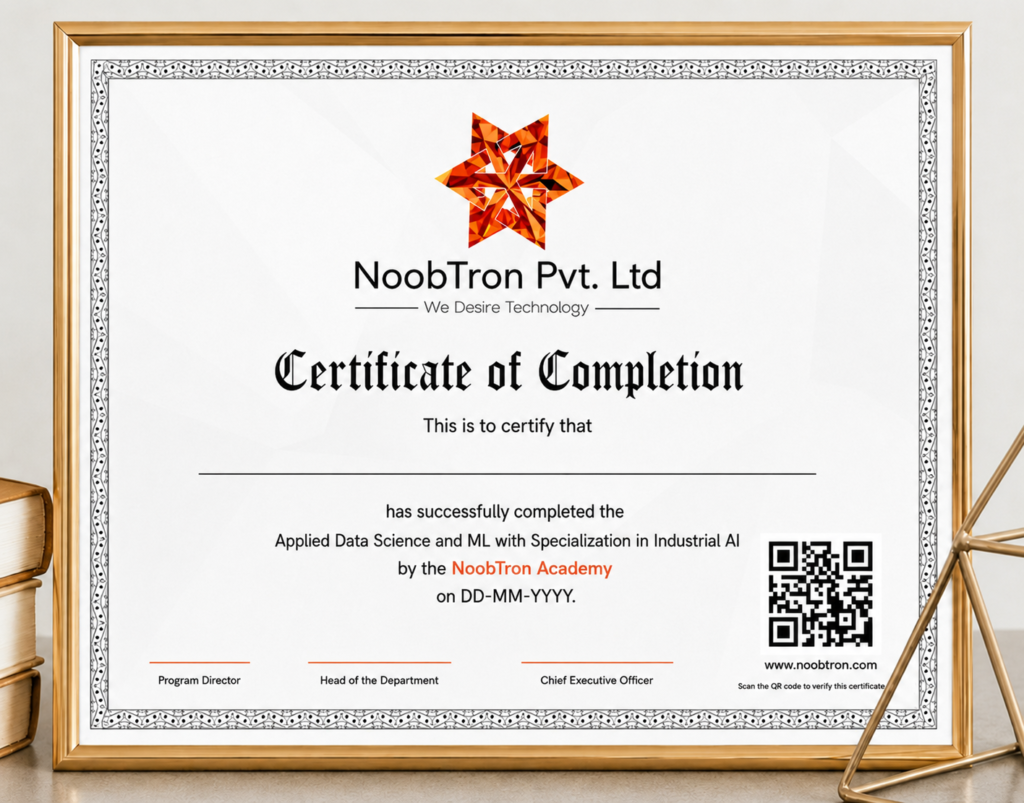
CERTIFICATION
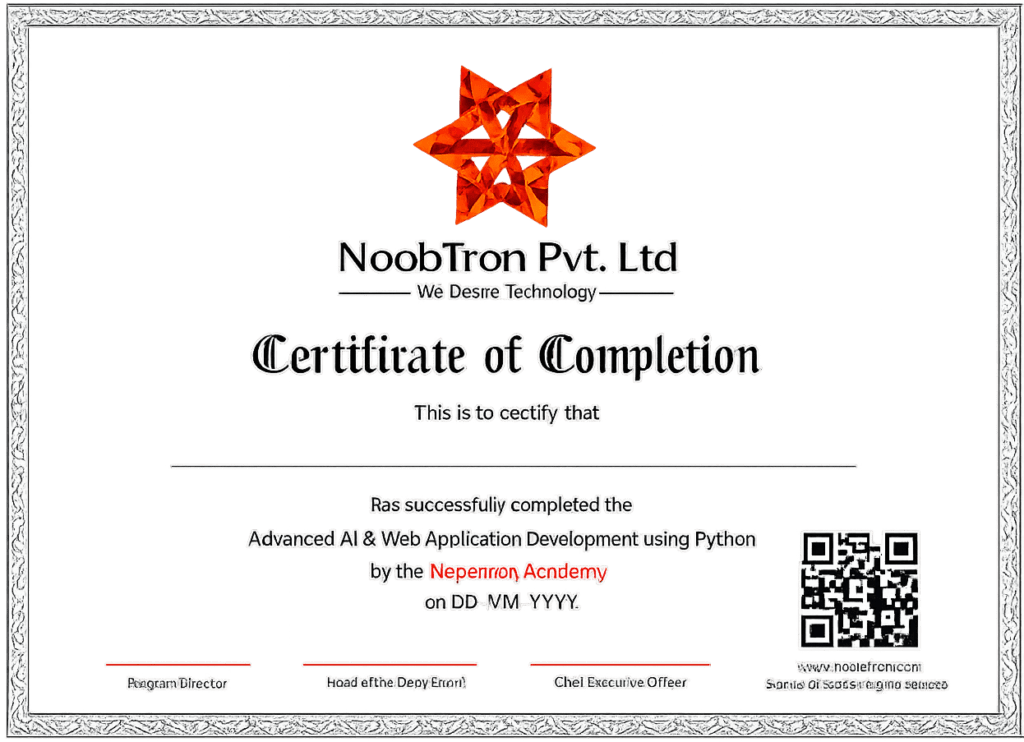
Earn an Industry-Recognized Certificate from NoobTron TechWorks
Successfully complete the Advanced AI & Web Development with Python program and receive a professional certification that validates your expertise in Python programming, Artificial Intelligence, modern web technologies, and real-world application development.
Demonstrate your readiness to build, deploy, and scale intelligent web applications with confidence.
Starting at
₹4,999 / Month*
Total Program Fee: ₹25,000*
Start Learning with Just ₹10,000
Upfront
Pay the remaining amount in 3 easy monthly installments of ₹4,999 each.
WHAT’S INCLUDED
Python Programming Mastery
Core Python, OOP, data handling, automation, and industry coding practices.
Artificial Intelligence & Generative AI
Prompt Engineering, AI APIs, LLM integration, AI agents, and intelligent automation.
Django, FastAPI, databases, REST APIs, frontend integration, and deployment.
Industry Projects & Certification
35%
Organizations worldwide are already using AI in at least one business function.
McKinsey Global Survey on AI, 2024
TIOBE Index, GitHub Octoverse, Stack Overflow Developer Survey
World Economic Forum – Future of Jobs Report 2025
Glassdoor, Indeed, Levels.fyi Industry Reports
WHERE INDUSTRIAL AI ENGINEERING CAN TAKE YOU
Organizations worldwide are investing in cloud modernization, security, automation, and digital transformation—making Azure cloud expertise one of the most valuable technology skill sets today.
INDUSTRY 4.0 REPORT, 2026
GLOBAL AI INDUSTRY REPORT, 2026
INTERNATIONAL INDUSTRIAL SURVEY, 2025
GLOBAL TECHNOLOGY HIRING TRENDS, 2026
The program is ideal for engineering students, graduates, working professionals, AI enthusiasts, automation engineers, and learners interested in Industrial AI & smart engineering technologies.
Unlike conventional theory-heavy programs, this course emphasizes industrial implementation, real-time AI applications, research-driven learning, automation workflows, and practical engineering exposure.
The curriculum includes Python, Applied Data Science, Machine Learning, Deep Learning, Computer Vision, Predictive Analytics, Industrial IoT, AI Deployment, MLOps, Automation Systems & Industry 4.0 technologies.
Yes. The program is structured progressively from fundamentals to advanced Industrial AI implementation, making it suitable for both beginners and experienced learners.
Yes. The curriculum is continuously aligned with emerging AI technologies, industrial requirements, automation ecosystems, and next-generation engineering practices.
Yes. Learners work on industrial AI case studies, predictive maintenance systems, anomaly detection models, automation workflows, intelligent analytics systems, and deployment-based projects.
Absolutely. Projects are designed around manufacturing, smart systems, industrial automation, AI-driven operations, and Industry 4.0 applications.
Yes. Every learner develops a technical portfolio consisting of AI applications, industrial case studies, predictive analytics systems, and deployment-oriented solutions.
Yes. The program encourages research-oriented learning through innovation projects, industrial problem-solving, technical publications, and emerging AI technologies.
Yes. Learners may receive exposure to startup founders, industrial professionals, researchers, technical mentors, and innovation ecosystems through sessions and collaborative activities.
Yes. Learners are encouraged to identify real-world problems, engineer AI-driven solutions, and understand how technology evolves from concept to implementation.
Yes. The program includes resume guidance, portfolio development, mock interviews, technical mentoring, and career-oriented support.
Learners can pursue roles such as Machine Learning Engineer, Data Scientist, Industrial AI Engineer, Computer Vision Engineer, Automation Analyst, AI Deployment Engineer, and Predictive Analytics Specialist.
Yes. The entire learning ecosystem is designed to provide practical industrial exposure, real-time implementation experience, and industry-oriented technical competence.
Yes. Flexible EMI and installment options are available for eligible learners.
Yes. The program is designed to support students, fresh graduates, and working professionals through flexible learning structures.
Yes. Learners receive access to learning materials, recorded sessions, project resources, and future curriculum updates based on the program structure.
Absolutely. Learners can connect with the NoobTron TechWorks advisory team for personalized career guidance, curriculum clarification, and program consultation.