< NoobTron TechWork |3 Months >
Specialisation in Computer Vision, Digital Twins, Swarm Systems and Aerospace Automation.
Industry-Aligned. Future-Ready.




Learn industry-relevant methodologies and tools from leading organizations shaping the future of autonomous aerial systems, robotics and intelligent technologies.
Hands-on Training. Real-world Projects. Career Ready.
DURATION
4 Months
Comprehensive, immersive program with hands-on labs and real-world autonomous drone engineering projects.
FOCUS
Drone AI, UAV Engineering & Autonomous Systems
Autopilot Systems (PX4, ArduPilot), ROS 2, Computer Vision, SLAM & Sensor Fusion, Mission Planning, Swarm Systems, Digital Twins, BVLOS, and More.
LEARN
From Industry Experts
Learn with methodologies and tools used by autonomous systems professionals and aerospace engineers.
OUTCOME
Job-Ready Skills
Build, test & deploy intelligent drone solutions and apply them with confidence in real-world aerospace, defence, surveying and industrial environments.
NOTE: This program covers Autopilot Systems, ROS 2, Computer Vision, SLAM, Sensor Fusion, Communication Protocols, Flight Dynamics, Digital Twins, Swarm Intelligence, BVLOS Operations, GIS/Photogrammetry and related tools.
Other programmes teach drone operations.
We teach you to engineer intelligent UAV systems that navigate, perceive, analyse and act autonomously.
AI runs through every layer of this program—from flight control, autonomous navigation and computer vision to digital twins, swarm intelligence and advanced mission systems. Here’s how:
AI-Enabled UAV Curriculum
From drone architecture and flight dynamics to autonomous navigation, ROS2, SLAM, Computer Vision, Digital Twins and BVLOS operations. Learn the technologies powering next-generation intelligent aerial systems.
Advanced UAV Engineering Labs
Build, configure and test real-world drone systems using PX4, ArduPilot, QGroundControl, MAVLink, ROS2 and Gazebo. Simulate complex missions before deploying them in operational environments.
Industry-Focused Mission Challenges
Practice autonomous mission planning, aerial surveying, payload integration, swarm coordination and AI-powered decision-making through practical engineering scenarios used across aerospace, defence and industrial sectors.
Capstone UAV Portfolio
Develop a complete Drone AI project portfolio featuring autonomous navigation, Computer Vision models, Digital Twin simulations, aerial analytics and advanced UAV mission architectures.


4 Industry-Ready Experiences That Go Beyond Training
From foundational UAV engineering to advanced AI-powered autonomous systems, every stage is designed to build real-world skills, professional portfolios and career readiness.
From foundational cloud services to enterprise deployment strategies, every module focuses on practical implementation, automation, security, and operational excellence on Google Cloud Platform
Design, configure and deploy a complete UAV platform from the ground up. Learn drone architecture, PX4/ArduPilot flight controllers, sensor integration, telemetry systems and mission planning while developing a fully functional autonomous drone solution.
Build Computer Vision and Deep Learning models for drones using OpenCV, YOLOv8 and NVIDIA Jetson. Create intelligent aerial systems capable of object detection, tracking, inspection and real-time decision-making.
Develop high-fidelity UAV simulations using ROS2, Gazebo and AirSim. Test autonomous navigation, SLAM, swarm coordination and mission scenarios in virtual environments before real-world deployment.
Plan and deliver industry-relevant projects in aerial surveying, photogrammetry, infrastructure inspection, autonomous navigation, BVLOS operations and intelligent drone applications across aerospace, defence and industrial sectors.
A process built for results
Clear milestones, constant communication, and zero hand-waving. Here’s how we get from idea to impact.
STEP 1
Discovery & Success Criteria
We map your current workflows, identify bottlenecks, and define clear metrics for success.
STEP 2
Map Workflows + Data Access
We map your current workflows, identify bottlenecks, and define clear metrics for success.
STEP 3
Build + Test + Security Review
We map your current workflows, identify bottlenecks, and define clear metrics for success.
STEP 4
Launch + Monitor + Iterate
We map your current workflows, identify bottlenecks, and define clear metrics for success.
A step-by-step guide
Executive Program in Drone AI, UAV Engineering & Autonomous Systems
Clear milestones, constant communication, and zero hand-waving. Here’s how we get from idea to impact.
STEP 1
Explore the Program Curriculum
Drone AI, UAV Engineering & Autonomous Systems

Review the detailed curriculum, modules, tools, and learning outcomes designed for real-world drone engineering. Covers PX4, ArduPilot, ROS2, Computer Vision, SLAM, Digital Twins, BVLOS, swarm systems and more.
STEP 2
Submit your application
Fill in your basic details, academic background, and work experience (if any). Upload the required documents and complete your application.
STEP 3
Registration completion
Once your application is reviewed and approved, complete the registration process by making the payment to confirm your seat in the batch.
STEP 4
NoobTron Trainee Offer Letter
Be ready with the course schedule
Receive your NoobTron Trainee Offer Letter and get access to the complete course schedule, batch timeline, and onboarding resources. Get ready to begin your journey into Drone AI, UAV Engineering & Autonomous Systems with NoobTron!
Prefer to talk first? +1 (234) 567-890
Learn. Solve. Grow.
Solve Real-World Problems as a Software Developer
Work on real industrial challenges, collaborate with experts, and build solutions that make an impact.
Real-World Projects
Work on live industry problems from 100+ companies.
Expert Mentorship
Learn and get guidance from industry experts and senior developers.
Build & Deliver Solutions
Apply your skills to design, code, and deliver impactful solutions.
Enhance Your Portfolio
Showcase real projects and strengthen your developer portfolio.
Recognized Certification
Earn a certificate that validates your skills and boosts your career.
Program Director
Lead. Empower. Deliver Impact.
WHY CHOOSE US
Our programs help learners to use AI more confidently in day-to-day work. We combine education, real examples, and guided practice so people leave with skills they can apply immediately.
Case based Classroom
Meeting-Style Discussion & Debate
Case based Classroom
Meeting-Style Discussion & Debate
Case based Classroom
Meeting-Style Discussion & Debate
Case based Classroom
Meeting-Style Discussion & Debate
India’s drone ecosystem expands: 38,575 UAVs registered, 39,890 pilots certified as of February 2026
India has built a regulated drone ecosystem as of February 2026, with more than 38,500 registered drones, 39,890 DGCA-certified remote pilots and 244 approved training organisations in operation, the Press Information Bureau said in a statement on Tuesday.
Feb 18, 2026, 17:21 IST
TOI News Desk
4 Mins Read
DOWNLOAD REPORT
VIEW DIRECT LINK
0-3 Years
Engineering Graduates, Drone Enthusiasts & UAV Beginners
Engineering Graduates, Drone Enthusiasts & UAV Beginners
You know the fundamentals of engineering. Now build the skills required to design, operate and develop next-generation intelligent drone systems used across aerospace, defence, surveying, agriculture and autonomous technologies.
WHAT YOU'LL GAIN
Strong foundation in UAV systems, flight dynamics and drone architecture
Hands-on experience with PX4, ArduPilot, Mission Planner and QGroundControl
Practical exposure to drone assembly, calibration, autonomous missions and aerial data acquisition
Introduction to AI-enabled drones, Computer Vision and autonomous flight technologies
3-7 Years
Drone Operators, Robotics Engineers & Embedded Systems Professionals
Drone Operators, Robotics Engineers & Embedded Systems Professionals
Advance beyond drone operations and gain expertise in autonomous navigation, ROS, photogrammetry, payload integration and UAV software development.
WHAT YOU'LL GAIN
Autonomous mission planning and waypoint navigation
ROS2, MAVLink and DroneKit-based UAV development
GIS, photogrammetry and aerial analytics workflows
Industry-ready skills in drone automation and intelligent aerial systems
7-12Years
UAV Engineers, AI Developers & Aerospace Professionals
UAV Engineers, AI Developers & Aerospace Professionals
Develop advanced capabilities in drone intelligence, computer vision, swarm systems, digital twins and BVLOS operations for large-scale industrial and defence applications.
WHAT YOU'LL GAIN
AI-powered perception using Computer Vision and Deep Learning
SLAM, Sensor Fusion and GPS-denied autonomous navigation
Swarm intelligence and multi-agent drone coordination
Digital Twin simulation and advanced UAV system validation
12+ years
Aerospace Leaders, R&D Specialists & Technology Architects
Aerospace Leaders, R&D Specialists & Technology Architects
Lead the design and deployment of next-generation autonomous UAV ecosystems integrating AI, robotics, cloud platforms and intelligent decision-making systems.
WHAT YOU'LL GAIN
Enterprise-scale UAV architecture and autonomous system design
BVLOS mission planning, regulatory compliance and UTM integration
AI-driven drone ecosystems with Computer Vision, GenAI and analytics
Strategic leadership in aerospace innovation and autonomous technologies
“I wanted more than drone piloting. I wanted to build intelligent autonomous systems that combine AI, robotics and aerospace engineering.”
— Drone AI & Autonomous Systems Learner
Who is NoobTron ElectroLab For?
Engineering Graduates & UAV Aspirants
Build strong foundations in drone technology, autonomous flight systems, UAV engineering and AI-powered aerial intelligence.
Drone Pilots, Robotics & Electronics Professionals
Advance into autonomous navigation, PX4, ArduPilot, ROS2, Computer Vision and intelligent mission planning.
AI, Aerospace & Defence Technology Enthusiasts
Master SLAM, Digital Twins, Swarm Intelligence, BVLOS operations and next-generation autonomous UAV systems.
Curriculum Designed For Google Cloud Foundations to Professional Cloud Engineering Mastery
Module 1
- 3 hrs
GCP Fundamentals & Console
What is Cloud Computing & GCP overview
GCP Console, Cloud Shell & gcloud CLI setup
Resource hierarchy: Org → Folder → Project → Resource
Creating and managing GCP projects
Enabling APIs and navigating Marketplace
Regions, Zones & Global infrastructure
Working development environment ready for Django projects
Module 2
- 5 hrs
Compute Engine Basics
VM instance types: general-purpose, compute-optimized
Launching Linux & Windows VMs from Console & CLI
SSH keys, OS Login, and remote access methods
Attaching and managing persistent disks
Startup scripts and metadata configuration
Spot (preemptible) VMs — use cases and savings
Custom machine types for right-sizing
Confident Python fundamentals to write Django views and models
Module 3
- 4 hrs
IAM & Identity Basics
IAM concepts: members, roles, policies
Basic roles: Owner, Editor, Viewer
Granting and revoking roles on projects
Cloud Identity: users & groups management
Principle of least privilege
Introduction to service accounts
Navigate any Django project structure with confidence
Module 4
- 2 hrs
Billing & Account Setup
Creating and managing billing accounts
Linking projects to billing accounts
Setting up billing budgets and alerts
Billing export to BigQuery & Cloud Storage
Free tier & cost estimation with Pricing Calculator
Create, read, update, delete database records using the ORM
Module 5
- 4 hrs
Cloud Storage Essentials
Storage classes: Standard, Nearline, Coldline, Archive
Creating and configuring buckets
Uploading objects: Console, gsutil & JSON API
Access control: IAM vs ACLs
Object lifecycle management policies
Hosting a static website on Cloud Storage
End-to-end request/response cycle: URL → view → template → HTML
Module 6
- 4 hrs
Networking Foundations
VPC networks: auto vs custom mode
Subnets, CIDR ranges, and routing basics
Creating firewall rules: ingress and egress
External vs internal IP addresses
Cloud DNS basics
Network Service Tiers (Premium vs Standard)
End-to-end request/response cycle: URL → view → template → HTML
Technical Pre-requisites
- Linux Basics
- Networking Fundamentals
- Basic Programming Knowledge
- Understanding of Cloud Concepts
- GCP Enterprise Infrastructure Deployment
- Kubernetes Cluster on GKE
- Cloud-native Application Deployment
- BigQuery Data Analytics Platform
- Google Compute Engine
- Google Kubernetes Engine (GKE)
- Cloud Storage & IAM
- BigQuery & Cloud Monitoring
Module 1
- 7 hrs
Google Kubernetes Engine (GKE)
Containers & Docker refresher for GCP
kubectl CLI setup and core commands
GKE cluster types: Autopilot vs Standard
Regional, zonal, and private clusters
Deploying containerized apps to GKE
Pods, Deployments, Services, StatefulSets
Node pools: add, edit, remove
Horizontal & Vertical Pod Autoscaling
Connecting GKE to Artifact Registry
Write DRY, maintainable views using Django's generic CBV system
Module 2
- 6 hrs
Data Storage & Databases
Choosing the right database: decision framework
Cloud SQL: MySQL, PostgreSQL, SQL Server
BigQuery: data warehouse fundamentals & queries
Firestore: NoSQL document store
Spanner: globally distributed relational DB
Bigtable: wide-column for IoT & time-series
AlloyDB: PostgreSQL-compatible high performance
Loading data: CLI, Storage Transfer, Dataflow
Backup and restore strategies
Handle complex user input securely with full server-side validation
Module 3
- 5 hrs
Advanced Networking
Shared VPC: host and service projects
VPC Network Peering configuration
Cloud VPN: HA VPN and Classic VPN
Load balancing types: HTTP(S), TCP, UDP, Internal
Cloud NAT: private instance internet access
Reserving static IPs (internal & external)
Expanding subnets and adding IP ranges
Full registration/login system with role-based access control
Module 4
- 5 hrs
Cloud Run & Cloud Functions
Serverless vs containerized workloads
Deploying apps on Cloud Run (fully managed)
Traffic splitting & blue/green deployments
Cloud Run autoscaling configuration
Cloud Functions: 1st gen vs 2nd gen
Event-driven triggers: Pub/Sub, Cloud Storage, Eventarc
When to choose Run vs Functions vs GKE
Seamless partial-page updates — no full reloads for common actions
Module 5
- 4 hrs
Advanced Compute Engine
Instance templates and managed instance groups
Autoscaling policies: CPU, HTTP, custom metrics
VM snapshots: create, schedule, restore, delete
Custom images from VMs and snapshots
VM Manager: patch management & inventory
Configuring OS Login for secure access
Users can upload profile photos, documents, and media files
Module 6
- 5 hrs
Monitoring & Logging
Google Cloud Observability stack overview
Cloud Monitoring: dashboards and uptime checks
Creating metric-based alerting policies
Custom metrics from apps and logs
Cloud Logging: log buckets, routers, sinks
Exporting logs to BigQuery & external systems
Using Cloud Diagnostics for troubleshooting
Ops Agent and Managed Service for Prometheus
Audit log configuration
Write efficient database queries; avoid common performance pitfalls
- Beginner level completed
- Comfortable with Django MTV
- Basic JavaScript knowledge
- Familiar with HTML forms
- Task manager with user accounts
- AJAX live updates (add/complete)
- User profile with photo upload
- Role-based dashboard access
- Class-Based Views mastery
- Full authentication system
- AJAX + Django integration
- Advanced ORM queries
Technical Pre-requisites
- Linux Basics
- Networking Fundamentals
- Basic Programming Knowledge
- Understanding of Cloud Concepts
- GCP Enterprise Infrastructure Deployment
- Kubernetes Cluster on GKE
- Cloud-native Application Deployment
- BigQuery Data Analytics Platform
- Google Compute Engine
- Google Kubernetes Engine (GKE)
- Cloud Storage & IAM
- BigQuery & Cloud Monitoring
Module 1
- 5 hrs
IAM Deep Dive & Security
Predefined vs custom IAM roles
Creating custom roles with granular permissions
Organizational policies and constraints
Service accounts: creation, binding, impersonation
Workload Identity Federation
Short-lived credentials & service account keys
VPC Service Controls and Security Command Center
Identity-Aware Proxy (IAP)
Build a fully documented, authenticated REST API from scratch
Module 2
- 4 hrs
Advanced GKE & Enterprise
GKE Enterprise (Anthos) overview
Multi-cluster management and fleet management
Private GKE clusters with authorized networks
Cloud Run for Anthos vs Cloud Run managed
Binary Authorization for container security
GKE Dataplane V2 and network policies
Confident Python fundamentals to write Django views and models
Module 3
- 3 hrs
ACE Exam Preparation & Mock Tests
Exam format: 50 questions, 2 hours, multiple choice
High-weightage topic review and cheat sheets
Scenario-based question strategies
Practice exam with timed conditions
Common traps: over-provisioning, wrong service selection
Official GCP sample questions walkthrough
Post-exam review and weak area reinforcement
Exam-day tips and registration guidance
Offload heavy operations; keep response times instant for users
Module 4
- 5 hrs
Infrastructure as Code (IaC)
Terraform for GCP: providers, resources, state
Terraform init, plan, apply, destroy workflow
Managing GCP resources with Terraform modules
Cloud Foundation Toolkit (CFT) blueprint templates
Config Connector: Kubernetes-native GCP resources
Helm charts for GKE application packaging
GitOps workflows with Cloud Build & Artifact Registry
Ship with confidence: every PR tested and style-checked automatically
Module 5
- 3 hrs
Reliability & Cost Optimization
SLOs, SLIs, SLAs in GCP context
Multi-region architectures and failover design
Committed Use Discounts (CUDs) vs Spot VMs
Quota management and increase requests
Cloud Recommender: idle resources & rightsizing
Billing report analysis and cost breakdown
Containerized, hardened app ready for any cloud or VPS environment
Technical Pre-requisites
- Linux Basics
- Networking Fundamentals
- Basic Programming Knowledge
- Understanding of Cloud Concepts
- GCP Enterprise Infrastructure Deployment
- Kubernetes Cluster on GKE
- Cloud-native Application Deployment
- BigQuery Data Analytics Platform
- Google Compute Engine
- Google Kubernetes Engine (GKE)
- Cloud Storage & IAM
- BigQuery & Cloud Monitoring
NoobTron TechWorks
Learners work at Leading Cloud & Tech Companies Worldwide





























Get Expert Career Guidance in Drone AI & UAV Engineering
Talk to our mentors and discover the right pathway into the rapidly growing drone and autonomous systems industry.
Get personalized guidance on Drone AI, UAV Engineering and future career pathways.
FEES & ENROLLMENT
Starting at
₹6,667/month*
Total Program Fee ₹80,000*
Master Drone AI, UAV Engineering & Autonomous Systems through hands-on learning, industry projects and expert mentorship.
Build future-ready skills in autonomous aviation, AI-powered drones and intelligent aerial systems with flexible payment options.
WHAT’S INCLUDED
Industry-Focused Curriculum
Comprehensive coverage of UAV Engineering, Autonomous Navigation, Computer Vision, ROS2 and Drone AI Technologies.
Hands-On Engineering Labs
Work with PX4, ArduPilot, Gazebo, AirSim, MAVLink, OpenCV, NVIDIA Jetson and real-world UAV workflows.
Lifetime Access to Learning Resources
Access course materials, recordings, project references and future curriculum updates.
Career & Project Support
Portfolio guidance, project reviews, technical mentoring and career readiness support
Our Success is Reflected in the Achievements of Our Learners
Discover how NoobTron ElectroLab™ has empowered aspiring UAV engineers, drone technology professionals and autonomous systems innovators to build practical skills, execute real-world projects and advance their careers in the rapidly evolving drone ecosystem.
"The Drone AI & Autonomous Systems program gave me hands-on exposure to PX4, ROS2, Computer Vision and autonomous mission planning. The practical approach and industry-focused projects helped me gain confidence in developing real-world UAV solutions."
"Learning Computer Vision, Digital Twins and UAV simulation transformed my understanding of intelligent aerial systems. The mentorship and project-driven curriculum helped me build a strong portfolio aligned with industry requirements."
"The program covered everything from drone architecture and flight controllers to SLAM and swarm intelligence. The real-world applications and technical guidance provided an exceptional learning experience."
"The training in photogrammetry, GIS mapping and autonomous drone operations helped me develop valuable skills for surveying and infrastructure applications. The hands-on sessions made complex concepts easy to understand."
Ready to Become a Google Cloud Professional?
CERTIFICATE
A Credential That Reflects Real Engineering Skills
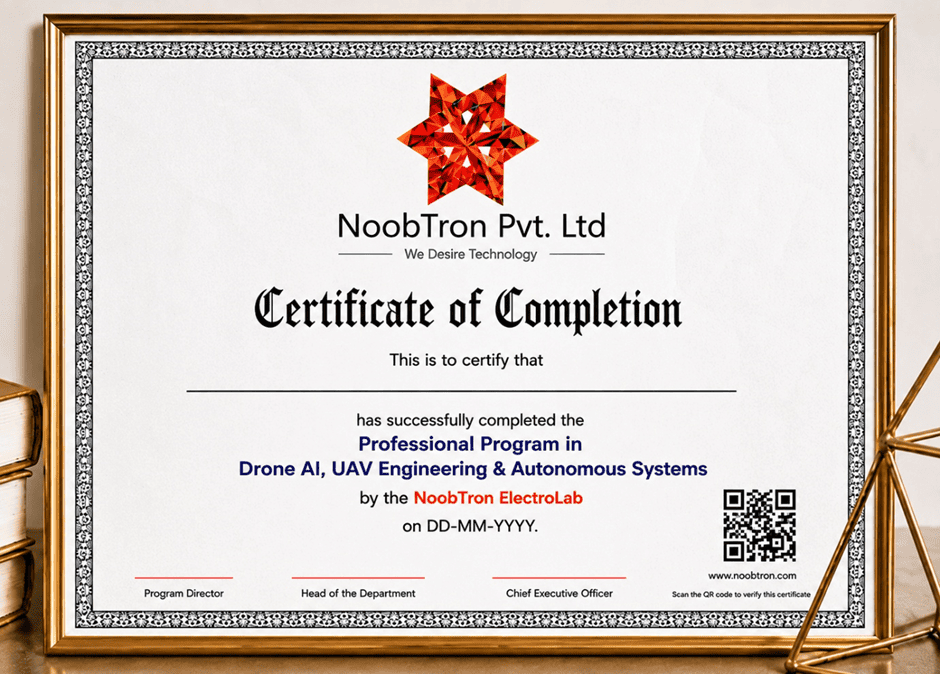
Upon successful completion of the program, you will receive the NoobTron ElectroLab Certificate of Excellence in Drone AI, UAV Engineering & Autonomous Systems.
Autonomous Aviation is Transforming Industries.
Drone AI is creating new opportunities across aerospace, defence, surveying and intelligent mobility.
500K+
Commercial drones are expected to be operating globally across industrial, logistics, inspection and surveying applications by the end of this decade.
Source: Industry forecasts from drone market research reports
$90B+
Projected global drone market opportunity by the early 2030s, driven by defence, infrastructure inspection, agriculture and autonomous systems.
Source: Global UAV Industry Analysis Reports
70%+
Of advanced drone applications increasingly rely on AI technologies such as Computer Vision, autonomous navigation, SLAM and intelligent decision-making systems.
Source: Industry surveys and autonomous systems research publications
1000s
Of new UAV, robotics, aerial intelligence and autonomous systems roles are emerging globally as industries adopt next-generation drone technologies.
Source: Aerospace, Robotics & UAV Industry Hiring Trends
This industry-focused program is designed to equip learners with practical expertise in UAV engineering, autonomous navigation, Computer Vision, ROS2, Digital Twins, Swarm Intelligence and next-generation Drone AI technologies through hands-on projects and real-world applications.
The program is suitable for engineering students, graduates, drone enthusiasts, UAV pilots, robotics professionals, electronics engineers, embedded systems developers, AI practitioners and professionals interested in autonomous aviation technologies.
No. The curriculum begins with drone fundamentals and progressively advances to autonomous systems, AI-powered aerial intelligence and advanced UAV engineering concepts.
Unlike traditional drone training programs that focus primarily on piloting, this program emphasizes engineering, autonomous systems development, AI integration, Computer Vision and real-world UAV applications.
You will work with industry-relevant technologies including PX4, ArduPilot, ROS2, MAVLink, QGroundControl, Gazebo, AirSim, OpenCV, YOLO, NVIDIA Jetson, DroneKit, QGIS and Digital Twin platforms.
Yes. The program emphasizes hands-on learning through autonomous drone missions, Computer Vision applications, aerial mapping projects, Digital Twin simulations and real-world UAV engineering challenges.
Yes. The curriculum is designed around technologies and workflows used in aerospace, defence, surveying, agriculture, geospatial intelligence and autonomous systems industries.
Yes. Learners receive access to training materials, project resources, assignments and supporting learning content throughout the program.
Yes. The program covers object detection, image processing, aerial analytics, tracking systems, AI-based perception and Computer Vision applications for UAVs.
Yes. Learners gain hands-on experience with ROS2, autonomous navigation frameworks, simulation environments and robotics integration for UAV systems.
Yes. The curriculum includes Digital Twin concepts, Gazebo, AirSim and virtual mission simulation for testing autonomous drone systems.
Yes. Participants will be introduced to multi-agent drone systems, swarm coordination concepts and collaborative UAV operations.
Projects may include autonomous navigation systems, object detection drones, aerial surveying solutions, Digital Twin simulations, swarm intelligence demonstrations and AI-powered UAV applications.
Yes. Projects are inspired by practical challenges found in aerospace, defence, infrastructure inspection, agriculture and geospatial sectors.
Absolutely. Learners develop industry-relevant project portfolios demonstrating their technical skills in UAV engineering and Drone AI.
Yes. The program combines simulation-based training with practical UAV workflows and mission planning exercises.
Yes. Upon successful completion, participants receive a professional certification from NoobTron ElectroLab™ validating their expertise in Drone AI, UAV Engineering and Autonomous Systems.
Yes. The certification can be added to professional profiles, resumes, portfolios and career applications.
Yes. The certification reflects hands-on project work, technical assessments and practical UAV engineering experience gained during the program.
The certification demonstrates competency in emerging technologies such as autonomous navigation, Computer Vision, UAV systems and Drone AI.
Potential career pathways include UAV Systems Engineer, Drone AI Engineer, Autonomous Navigation Engineer, Computer Vision Engineer, Robotics Engineer, ROS2 Developer, Aerial Data & GIS Specialist and UAV Software Developer.
Aerospace, defence, agriculture, surveying, infrastructure inspection, logistics, geospatial intelligence, robotics and autonomous mobility sectors actively utilize UAV technologies.
Yes. The curriculum combines drone engineering, AI and autonomous systems, helping learners build skills relevant to emerging Drone AI opportunities.
Yes. The program provides a strong technical foundation for advanced research and academic pursuits in robotics, aerospace and autonomous systems.
Yes. Flexible payment and EMI options may be available. Contact the admissions team for current plans.
The program is designed as a 3-month intensive learning experience focused on practical skill development and project execution.
Yes. The program is structured to support students, graduates and working professionals looking to upskill in UAV technologies.
You can submit your application online and connect with our admissions team for counseling, eligibility guidance and enrollment support.