
< NoobTron TechWork |4 Months >
From battery cell fundamentals to intelligent Battery Management Systems (BMS), battery pack design, thermal management, testing, and energy storage technologies—built for engineers who want to lead the future of electric mobility and advanced energy systems.
Specialization in Battery Pack Design • BMS Hardware & Firmware • Battery Testing & Validation • Thermal Management • Energy Storage Systems (ESS)
Industry-Aligned. Future-Ready.










Learn industry-relevant methodologies and tools from leading organizations shaping the future of electric mobility and energy storage.
Hands-on Training. Real-world Tools. Career Ready.
DURATION
4 Months
Comprehensive, immersive program with hands-on industry projects.
FOCUS
EV Batteries, BMS & Energy Storage Engineering
Battery Technology, Pack Design
BMS Hardware & Firmware
Thermal, Testing & Validation
Energy Storage Systems (ESS)
LEARN
From Industry Experts
Learn with methodologies and tools used by industry leaders.
OUTCOME
Job-Ready Skills
Build, test & validate battery and BMS solutions and apply them with confidence.
NOTE:This program covers EV Battery Systems, BMS, Energy Storage Engineering, Thermal Management, Testing & Validation, and related industry tools.
BATTERY TECHNOLOGY IS EVOLUTIONIZING RAPIDLY
Other programs teach battery theory.
We teach you to engineer, validate, and optimize real-world EV battery systems.
From battery cell characterization and battery pack architecture to BMS development, thermal management, testing, and energy storage integration—this program prepares engineers for the technologies powering the future of electric mobility and sustainable energy.
Battery-Centric Curriculum
From lithium-ion cell fundamentals and electrochemistry to advanced battery pack engineering, learners gain the practical knowledge required to design and deploy industry-grade battery systems.
Hands-on Battery & BMS Labs
Perform battery characterization, cell balancing analysis, BMS hardware interfacing, thermal simulations, and battery performance validation using industry-relevant tools and methodologies.
EV Battery Engineering Interview Preparation
Practice battery engineering, BMS, testing, validation, and energy storage interview scenarios aligned with roles in EV OEMs, battery manufacturers, and energy storage companies.
Industry-Oriented Engineering Portfolio
Build a comprehensive portfolio including battery pack designs, BMS architectures, testing reports, thermal analysis studies, and energy storage engineering projects that demonstrate real-world expertise.









Industry-Driven Engineering Experiences
Move beyond theory and build practical expertise through real-world battery engineering projects, simulations, testing activities, and BMS development exercises aligned with EV and Energy Storage industries.
Learn how to select cells, configure series-parallel architectures, size battery packs, design electrical layouts, and evaluate performance for electric mobility applications.
Understand Battery Management System architecture, protection strategies, SOC estimation, balancing techniques, communication protocols, and embedded BMS development.
Conduct battery characterization, performance evaluation, thermal analysis, safety testing, and validation activities using industry-standard methodologies and engineering workflows.
Explore grid-scale and commercial energy storage applications, battery integration strategies, safety considerations, and next-generation energy management solutions.











A process built for results
Clear milestones, constant communication, and zero hand-waving. Here’s how we get from idea to impact.
STEP 1
Discovery & Success Criteria
We map your current workflows, identify bottlenecks, and define clear metrics for success.
STEP 2
Map Workflows + Data Access
We map your current workflows, identify bottlenecks, and define clear metrics for success.
STEP 3
Build + Test + Security Review
We map your current workflows, identify bottlenecks, and define clear metrics for success.
STEP 4
Launch + Monitor + Iterate
We map your current workflows, identify bottlenecks, and define clear metrics for success.
A step-by-step guide
Executive Program in EV Battery Systems, BMS & Energy Storage Engineering
Clear milestones, constant communication, and zero hand-waving. Here’s how we get from idea to impact.
STEP 1
Explore the Program Curriculum
EV Battery Systems, BMS & Energy Storage Engineering

Review the detailed curriculum, modules, tools, and learning outcomes designed for real-world EV battery systems, BMS, testing, and energy storage engineering roles.
STEP 2
Submit your application
Fill in your basic details, academic background, and work experience (if any). Upload the required documents and complete your application.
STEP 3
Registration completion
Once your application is reviewed and approved, complete the registration process by making the payment to confirm your seat in the batch.
STEP 4
NoobTron Trainee Offer Letter, Be Ready with the Course Schedule
Be ready with the course schedule
Receive your NoobTron Trainee Offer Letter and get access to the complete course schedule, batch timeline, and onboarding resources. Get ready to begin your learning journey with NoobTron!
Note: Seat allotment is on a first-come, first-served basis. Early application is recommended.
Learn. Solve. Grow.
Solve Real-World Problems as a Software Developer
Work on real industrial challenges, collaborate with experts, and build solutions that make an impact.
Real-World Projects
Work on live industry problems from 100+ companies.
Expert Mentorship
Learn and get guidance from industry experts and senior developers.
Build & Deliver Solutions
Apply your skills to design, code, and deliver impactful solutions.
Enhance Your Portfolio
Showcase real projects and strengthen your developer portfolio.
Recognized Certification
Earn a certificate that validates your skills and boosts your career.
Program Director
Lead. Empower. Deliver Impact.
WHY CHOOSE US
Our programs help learners to use AI more confidently in day-to-day work. We combine education, real examples, and guided practice so people leave with skills they can apply immediately.
Case based Classroom
Meeting-Style Discussion & Debate
Case based Classroom
Meeting-Style Discussion & Debate
Case based Classroom
Meeting-Style Discussion & Debate
Case based Classroom
Meeting-Style Discussion & Debate
THE TIMES OF INDIA | ENERGY NEWS
India energy storage boom: Battery capacity set to jump tenfold in 2026; major projects, policy support to drive surge

India is expected to see a sharp surge in battery energy storage capacity this year, with additions likely to rise almost ten times to around 5 GWh in 2026 from 507 MWh in 2025, driven largely by a massive pipeline of projects now moving into the execution stage.
According to a study released by the India Energy Storage Alliance (IESA), the coming year will mark a turning point for the sector as projects awarded over the past two years begin to come on stream.
5 GWh
Expected additions in 2026
10x Surge
Capacity jump compared to 2025
69 Tenders
Amounting to 102 GWh in 2025
224 GWh
Cumulative capacity under execution
DOWNLOAD REPORT
View Key Highlights
0–3 YEARS
Engineering Graduates, EV Enthusiasts & Early-Career Engineers
Engineering Graduates, EV Enthusiasts & Early-Career Engineers
Build a strong foundation in battery technology, battery pack design, and Battery Management Systems (BMS). Gain practical skills that help you transition into the rapidly growing EV and energy storage industry.
WHAT YOU’LL GAIN
Fundamentals of Lithium-Ion Batteries, Cell Chemistries & Energy Storage Technologies
Hands-on Exposure to Battery Pack Design, Configuration & Sizing
Introduction to BMS Hardware, Protection Circuits & Battery Safety Standards
3–7 YEARS
Electrical, Electronics, Embedded & Automotive Engineers
Electrical, Electronics, Embedded & Automotive Engineers
Advance your expertise in battery system design, embedded BMS development, testing, validation, and thermal management used across EV and ESS industries.
WHAT YOU'LL GAIN
Battery Pack Architecture, Thermal Design & Safety Engineering
BMS Hardware Design, Communication Protocols & Embedded Development
Battery Testing, Characterization, Validation & Industry Standards
7–12 YEARS
Senior Engineers, Technical Specialists & R&D Professionals
Senior Engineers, Technical Specialists & R&D Professionals
Develop advanced competencies in battery analytics, system integration, performance optimization, and next-generation energy storage technologies.
WHAT YOU'LL GAIN
Advanced BMS Algorithms, SOC/SOH Estimation & Fault Diagnostics
Battery Thermal Management Systems (BTMS) & System-Level Integration
AI-Driven Battery Analytics, Digital Twin & Predictive Health Monitoring
12+ YEARS
Technical Leaders, Engineering Managers & Solution Architects
Technical Leaders, Engineering Managers & Solution Architects
Lead battery innovation programs, energy storage deployments, and EV technology initiatives with a comprehensive understanding of battery systems engineering.
WHAT YOU'LL GAIN
EV Battery System Architecture, MBSE & Functional Safety Concepts
Energy Storage System (ESS) Design, Deployment & Lifecycle Management
Strategic Decision-Making for Battery Technology, Manufacturing & Commercialization
“I wanted more than theoretical battery knowledge. This program gave me the practical skills to design, analyze, test, and manage advanced EV battery systems with confidence.”
Who is NoobTron ElectroLab For?
Fresh Engineering Graduates & Final-Year Students
Build strong foundations in EV battery technology, battery pack engineering, Battery Management Systems (BMS), and energy storage technologies through practical, industry-oriented learning.
Electrical, Electronics, Automotive & Embedded Engineers
Upskill into one of the fastest-growing engineering domains by mastering battery pack design, BMS architecture, thermal management, testing, validation, and battery system integration.
Working Professionals, R&D Engineers & Industry Specialists
Advance your expertise with battery analytics, advanced BMS concepts, battery testing methodologies, energy storage applications, and next-generation battery technologies.
Industry-Focused Curriculum for Advanced EV Battery Systems & BMS Engineering
Module 1
Introduction to Batteries & Electrochemistry
- What is a battery? — primary vs secondary, history of energy storage
- Electrochemical fundamentals — oxidation, reduction, electrode potentials, Faraday’s laws
- Types of rechargeable batteries — Lead-Acid, NiMH, Li-ion, LiFePO4 — comparison
- Lithium-ion chemistry families: LCO, NMC, LFP, NCA, LTO — use case mapping
- Cell structure and components — anode, cathode, electrolyte, separator, current collectors
- Cell form factors — cylindrical (18650, 21700), prismatic, pouch
- Key performance metrics — capacity (Ah), energy density (Wh/kg), C-rate, cycle life
- Battery safety fundamentals — thermal runaway, dendrite formation, warning signs
- Battery applications — EVs, energy storage, consumer electronics, grid storage
- Introduction to battery standards and certifications — UN 38.3, IEC 62133, BIS
- Measure open-circuit voltage (OCV) of different cell types using multimeter
- Identify cell form factors and read datasheets: capacity, voltage range, C-rate limits
- Safety exercise: understand thermal runaway triggers using video case studies
- Digital multimeter
- Cell samples (18650, pouch)
- Datasheets
- Identify and compare Li-ion chemistries
- Read cell datasheets
- Understand thermal runaway risks
Cell datasheet analysis report comparing 3 Li-ion chemistries
Module 2
Battery Pack Concepts — Series, Parallel & Configurations
- Series vs Parallel cell connections — voltage, capacity, and current implications
- Mixed series-parallel configurations — 2S2P, 4S3P, nSnP notation
- Pack voltage and capacity calculations from cell specs
- Why cell balancing matters — cell mismatch and its impact on pack life
- Passive vs active balancing — concept overview
- Low-voltage packs (≤60V) vs high-voltage packs (>60V) — design and safety differences
- Battery module vs battery pack — hierarchy and terminology
- State of Charge (SOC) concept — what it means, why it is hard to measure
- Introduction to BMS — what it does, why it is essential
- Real-world pack examples — e-bicycle, e-scooter, EV car
- Calculate pack voltage and capacity for 4S3P configuration using provided cell specs
- Observe cell voltage mismatch on a sample 4S pack and record imbalance
- Sketch a simple wiring diagram for a 2S2P pack with fuse and connector
- Sample battery pack
- Multimeter
- Graph paper / drawing tool
- Design series-parallel cell configurations
- Calculate pack voltage and capacity
- Explain BMS necessity
Pack configuration worksheet — calculated specs for a 36V e-bike battery
Module 3
Basic Electronics for BMS
- Passive components — resistors, capacitors, inductors: roles in battery circuits
- Semiconductor devices — diodes, MOSFETs, BJTs: switching and protection basics
- Voltage regulators — LDO, SMPS: powering BMS control circuits
- Ohm’s Law, Kirchhoff’s Laws applied to BMS circuit analysis
- Understanding ICs — op-amps, comparators, logic gates in protection circuits
- Reading component datasheets — pin configurations, absolute maximum ratings
- Introduction to simulation tools — LTspice, Falstad Circuit Simulator
- Protection logic circuits — overvoltage and undervoltage comparator circuits
- Thermal considerations — power dissipation, heat management in electronics
- Introduction to PCB basics — layers, traces, pads, DRC concepts
- Build and test an overvoltage comparator circuit in LTspice
- Use Falstad to simulate a MOSFET switch circuit for battery disconnect
- Identify and measure passive components using LCR meter and multimeter
- LTspice
- Falstad Circuit Simulator
- LCR meter
- Component kit
- Simulate basic protection circuits
- Read component datasheets
- Identify BMS-relevant passive and active components
LTspice simulation of a basic cell overvoltage protection circuit
Module 4
BMS Functions & Architecture — Overview
- BMS functional overview — monitoring, protection, balancing, communication, estimation
- BMS topologies — centralized, distributed, modular: comparison and applications
- Cell voltage monitoring — AFE (Analog Front End) concept
- Temperature monitoring — NTC thermistor placement and signal conditioning
- Current sensing — shunt resistor method: working principle and limitations
- Protection features explained — OVP (Overvoltage), UVP (Undervoltage), OTP, SCP, OCD
- Pre-charge circuit — why it is needed, basic working principle
- Charge and discharge path control — MOSFET-based switches
- Communication interfaces overview — UART, I2C, SPI, CAN — what each is used for
- Introduction to microcontrollers in BMS — STM32, TI, NXP: role and selection criteria
- Draw a complete BMS block diagram from scratch using provided component list
- Measure NTC thermistor resistance vs temperature and plot a curve
- Calculate shunt resistor value for 10A current sensing with 50mV drop
- NTC thermistor kit
- Thermometer
- Graph tool
- Multimeter
- Describe BMS topologies and functions
- Explain protection features
- Identify AFE and current sensing methods
Annotated BMS block diagram with component-level notes
Module 5
MATLAB Fundamentals for Battery Engineers
- MATLAB environment — workspace, command window, script editor
- Variables, data types, arrays, and matrices in MATLAB
- Control flow — for/while loops, if-else, switch-case
- Writing and calling user-defined functions
- Plotting — line plots, scatter plots, subplots for battery data
- Reading and writing data files — CSV import/export for test data
- Basic signal processing — smoothing, filtering battery voltage data
- Introduction to Simulink — block diagram concept, basic source/sink blocks
- Simple Simulink model — RC circuit simulation as cell equivalent
- MATLAB for battery engineers — SOC calculation by Coulomb Counting script
- Write a MATLAB script to calculate Coulomb Counting SOC from current vs time data
- Plot a charge/discharge voltage curve from imported CSV test data
- Build a basic RC circuit model in Simulink and observe voltage response
- MATLAB + Simulink (student or trial license)
- Sample battery test CSV data
- Write MATLAB scripts for battery data analysis
- Plot and interpret charge/discharge curves
- Build basic Simulink models
MATLAB script for SOC estimation with plotted results and comments
Module 6
Battery Safety, Standards & Testing Basics
- Battery safety hazards — short circuit, overcharge, overdischarge, thermal runaway
- Personal protective equipment (PPE) and lab safety protocols for battery testing
- UN 38.3 standard — what tests are required for transportation certification
- IEC 62133 — safety requirements for portable rechargeable cells and packs
- BIS certification requirements for batteries in India
- Performance testing overview — capacity test, rate test, cycle life test
- Abuse testing concept — nail penetration, crush, overcharge, forced discharge
- Test bench components — cycler, environmental chamber, data acquisition
- Introduction to SOC-OCV curve generation — steps and significance
- Battery quality and grading — how manufacturers grade cells (voltage, IR, capacity)
- Conduct a basic charge/discharge cycle on a single cell using a benchtop charger
- Record voltage, current, and temperature during charge and plot on MATLAB
- Review a UN 38.3 test report and identify each test requirement
- Benchtop cell cycler / charger
- Thermocouple + logger
- UN 38.3 sample report
- Conduct safe single-cell charge/discharge testing
- Interpret UN 38.3 and IEC 62133 requirements
- Generate basic SOC-OCV data
Cell test report: capacity, OCV at different SOC points, temperature profile
Module 7
Beginner Capstone — Battery Pack Concept Design
- Application requirements analysis — voltage, capacity, continuous/peak current
- Cell selection — chemistry, form factor, and vendor comparison
- Series-parallel configuration design — calculating nS × nP
- BMS selection criteria for the application
- Simple electrical schematic — pack wiring, fuse, connector, BMS placement
- Basic thermal assessment — estimate heat generated at peak discharge
- Safety features list — what protections must be enabled
- Documentation — BOM (Bill of Materials), design rationale sheet
- Presentation skills — explaining design choices to non-technical stakeholders
- Design a 36V / 10Ah e-bike pack: cell selection, configuration, BMS spec
- Draw full electrical schematic with BMS, fuse, and pack connector
- Present design to peers for review and feedback session
- MATLAB (capacity sizing)
- EasyEDA or hand-drawn schematic
- Datasheet collection
- Size and configure a battery pack for a given application
- Select cells and BMS for target specs
- Document and present a battery design
Complete e-bike pack concept design document: BOM, schematic, safety checklist
Technical Pre-requisites
- Linux Basics
- Networking Fundamentals
- Basic Programming Knowledge
- Understanding of Cloud Concepts
- GCP Enterprise Infrastructure Deployment
- Kubernetes Cluster on GKE
- Cloud-native Application Deployment
- BigQuery Data Analytics Platform
- Google Compute Engine
- Google Kubernetes Engine (GKE)
- Cloud Storage & IAM
- BigQuery & Cloud Monitoring
Module 1
Advanced Cell Modeling — ECM & Physics-Based
- Equivalent Circuit Models — Rint, Thevenin (1RC), Dual Polarization (2RC): derivation
- Model parameter identification from test data — HPPC test methodology
- SOC-OCV curve fitting using MATLAB curve fitting toolbox
- Temperature-dependent parameter modeling — how R and C change with temperature
- Doyle-Fuller-Newman (DFN) model — conceptual understanding, P2D equations
- Empirical vs physics-based models — trade-offs for real-time BMS use
- Simulink block diagram for 1RC ECM — implementing dynamic voltage response
- Validation of ECM against real charge/discharge test data
- DCIR and ACIR measurement — Electrochemical Impedance Spectroscopy (EIS) basics
- Cell aging effects on model parameters — internal resistance growth, capacity fade
- Fit a 1RC ECM model to provided HPPC test data using MATLAB
- Build 2RC cell model in Simulink and validate against test data
- Simulate cell response under a dynamic drive cycle current profile
- MATLAB Curve Fitting Toolbox
- Simulink
- HPPC test dataset (CSV)
- Derive and implement ECM from cell test data
- Validate Simulink cell model
- Explain DFN model conceptually
Validated 2RC ECM Simulink model with parameter fitting report
Module 2
BMS Hardware Design — Schematic to BOM
- BMS functional block diagram — detailed design planning approach
- AFE IC selection — BQ76940, LTC6811, ISL94203: feature comparison
- Cell voltage measurement circuit — ADC, multiplexer, level shifting
- Temperature sensing circuit — NTC thermistor divider, ADC interface
- Current sensing — shunt resistor design, sense amplifier (INA226, INA139), Hall-effect
- MOSFET selection for charge/discharge path — gate drive requirements, RDS(on), ID ratings
- Gate driver ICs — bootstrap circuits, isolation requirements
- Protection circuit design — OVP, UVP, OTP, SCP, OCD using comparators and logic
- Pre-charge circuit — inrush current limiting, relay/contactor sequencing
- Microcontroller selection — STM32F0/F4, TI C2000, NXP: peripheral requirements for BMS
- Power supply for BMS logic — LDO/SMPS from pack voltage, isolation
- Full schematic capture in EasyEDA or KiCad — component placement and netlist
- Design and draw complete 4S BMS schematic in EasyEDA with all protection blocks
- Simulate AFE voltage reading circuit in LTspice for 3.0V–4.2V cell range
- Calculate shunt resistor and sense amp gain for ±50A current measurement
- EasyEDA / KiCad
- LTspice
- STM32 datasheet
- AFE IC datasheets
- Design a complete BMS hardware schematic
- Select AFE, MOSFET, and MCU
- Implement all primary protection circuits
Complete 4S BMS schematic with BOM and component selection rationale
Module 3
BMS PCB Design & Layout
- PCB layer stack — 2-layer vs 4-layer for BMS: signal integrity considerations
- Importing schematic netlist to PCB layout tool
- Footprint library management — standard and custom footprints
- Trace width and copper thickness — IPC-2221 calculations for current-carrying traces
- Power routing — wide traces, copper pours for high-current paths
- Thermal management on PCB — copper pours, thermal vias, exposed pads for MOSFETs
- Ground plane design — analog ground vs digital ground separation
- Decoupling capacitor placement for MCU and AFE power pins
- EMI/EMC layout guidelines — filtering, shielding, keep-out zones
- Design Rule Check (DRC) — clearance, annular ring, via constraints
- Gerber file generation — layer stack, drill files, pick-and-place CSV, BOM export
- 3D visualization — component height check and mechanical fit verification
- Layout a 2S–4S BMS PCB in KiCad from provided schematic netlist
- Run DRC and resolve minimum 5 layout violations
- Export complete Gerber package ready for PCB fabrication
- KiCad 6+
- EasyEDA (alternative)
- Altium viewer
- Create a production-ready BMS PCB layout
- Apply trace width and thermal design rules
- Export and verify Gerber files
Fabrication-ready BMS PCB: Gerber + drill + BOM + layout report
Module 4
BMS Algorithm Development — SOC, SOH, SOP, SOE
- Introduction to Model-Based Design (MBD) in Simulink
- SOC estimation — Coulomb Counting: implementation, reset strategy, drift error
- SOC estimation — OCV-SOC mapping: look-up table, interpolation, hysteresis
- SOC estimation — Extended Kalman Filter (EKF): state-space formulation, Q/R tuning
- SOH estimation — capacity fade tracking, internal resistance growth monitoring
- SOP (State of Power) — peak power capability estimation under thermal and voltage limits
- SOE (State of Energy) — remaining energy calculation and range estimation
- Battery derating logic — C-rate limit vs SOC, temperature, and SOH
- Cell balancing algorithms — passive (bleed resistor) and active (capacitive transfer)
- Fault detection using thresholds and state machines — OVP, OTP, SCP logic
- Simulink state machine (Stateflow) for BMS operating modes — idle, charge, discharge, fault
- MBD code generation concept — path to embedded C via Embedded Coder
- Implement EKF-based SOC estimator in Simulink using provided 2RC cell model
- Design and test passive balancing logic in Simulink with 4-cell imbalanced pack
- Build Stateflow state machine for BMS charge/discharge/fault mode transitions
- MATLAB Simulink + Stateflow
- EKF tutorial dataset
- 2RC model from Module 1
- Implement SOC estimation using EKF
- Design SOH and balancing algorithms
- Build BMS state machine in Stateflow
Simulink BMS logic model: SOC/SOH/balancing/fault blocks with test results
Module 5
BMS Firmware Development — Embedded C on STM32
- Embedded firmware architecture for BMS — layered design: BSP, HAL, application
- Reading STM32 datasheet — peripheral mapping, clock tree, GPIO configuration
- Peripheral driver development — ADC, SPI, I2C, UART, timers in STM32CubeIDE
- AFE IC driver — writing SPI/I2C register-level communication for BQ76940 or LTC6811
- Coulomb counting implementation in firmware — interrupt-driven ADC sampling
- Real-time task scheduling — baremetal superloop vs RTOS (FreeRTOS basics)
- CAN bus driver for BMS — transmitting SOC, voltage, temperature, fault frames
- UART-based diagnostics — debug console, parameter dump, fault logging
- Integrating Simulink-generated SOC code into STM32 firmware (Embedded Coder workflow)
- Firmware testing strategies — unit testing, watchdog timer, fault injection
- Debugging tools — STM32CubeIDE debugger, SWD/JTAG, oscilloscope, logic analyser
- Firmware version control — Git workflow for embedded projects
- Read cell voltage from AFE IC (BQ76940 eval board) via I2C/SPI driver on STM32
- Implement CAN frame transmission of SOC, voltage, and fault status
- Integrate Simulink-generated SOC algorithm into STM32 firmware and validate on hardware
- STM32 Nucleo / eval board
- STM32CubeIDE
- BQ76940 eval kit
- Logic analyser
- Write peripheral drivers for BMS AFE ICs
- Implement real-time BMS firmware
- Transmit SOC and fault data over CAN
Functional BMS firmware on STM32: reads AFE, estimates SOC, transmits CAN frames
Module 6
Battery Pack Design — Mechanical, Electrical & Thermal
- Cell sorting and matching — voltage, IR, and capacity grading methodology
- Busbar design — material (copper vs aluminium), cross-section, resistance, heat
- Tab welding and mechanical interconnects — spot welding, laser welding, ultrasonic
- Pack electrical schematic — fuses, contactors, service disconnect, HV interlock
- Isolation and insulation — creepage and clearance, HiPot test requirements
- Mechanical enclosure design — material selection, IP rating, venting, mounting
- Vibration and shock resistance — IATF/ISO requirements for automotive packs
- Thermal Interface Materials (TIM) — thermal pads, phase change materials
- Cooling system integration — air cooling vs liquid cooling channel design
- Low-voltage vs high-voltage pack design differences — safety and regulatory
- Battery pack BOM and cost estimation — cell, BMS, interconnects, enclosure
- Design a 48V / 20Ah pack: busbar sizing, fuse selection, BMS wiring schematic
- Sketch a 3D enclosure concept for the pack with cooling channel placement (CAD or hand sketch)
- Calculate temperature rise in busbar under 50A continuous load
- EasyEDA / schematic tool
- MATLAB (thermal calc)
- FreeCAD / SolidWorks (optional)
- Design electrical and mechanical layout of a battery pack
- Size busbars and cooling for thermal targets
- Specify enclosure to meet IP and vibration requirements
Complete 48V pack design: schematic + BOM + thermal assessment + CAD sketch
Module 7
Communication Protocols — CAN, LIN, SMBus, UART in BMS
- CAN bus fundamentals — differential signalling, arbitration, frame types (data, remote, error)
- CAN database — DBC file structure, message and signal definition
- BMS CAN messages — standard frames: SOC, voltage, temperature, fault, pack status
- Extended CAN (CAN FD) — bandwidth improvement, bit rate switching
- LIN bus — master/slave architecture, use in low-speed BMS auxiliary channels
- SMBus / I2C — battery gas gauge ICs, smart battery standard
- UART-based diagnostics — simple ASCII protocol for BMS service interface
- UDS (Unified Diagnostic Services) — basics of ISO 14229 diagnostic sessions
- OBD-II port integration — reading EV battery data via standard PIDs
- CANoe / CANalyzer — trace capture, bus monitoring, frame filtering
- Protocol selection guide — choosing CAN, LIN, or UART based on application needs
- Transmit and receive BMS CAN frames using STM32 and analyse in CANoe or SavvyCAN
- Create a DBC file with 3 BMS messages and import to CANoe for monitoring
- Implement a UDS ReadDataByIdentifier service for SOC and pack voltage on STM32
- CANoe (trial) / SavvyCAN (free)
- STM32 + CAN transceiver
- DBC editor
- Design BMS CAN message database (DBC)
- Implement CAN and UART firmware drivers
- Use CANoe for bus diagnostics
BMS CAN DBC file + firmware CAN driver + CANoe trace screenshot report
Module 8
Battery Testing & Characterisation — Intermediate Level
- Test bench setup — cell cycler (Neware, Biologic, Chroma), temperature chamber, DAQ
- HPPC (Hybrid Pulse Power Characterisation) test — protocol, data extraction
- OCV-SOC characterisation — full charge/discharge at C/10 with voltage recording
- Rate performance test — capacity at different C-rates: 0.2C, 0.5C, 1C, 2C
- Cycle life test — protocol design, capacity retention vs cycle number
- Thermal profiling — surface temperature map during charge and discharge
- DCIR measurement — pulse method at different SOC and temperature points
- EIS (Electrochemical Impedance Spectroscopy) — basics, Nyquist plot interpretation
- Data analysis in MATLAB — automated test report generation from raw CSV
- Weld quality testing — contact resistance check for busbar welds
- Run HPPC test on a cell and extract R0, R1, C1 parameters for ECM fitting
- Perform a cycle life test for 20 cycles and plot capacity retention curve
- Analyse EIS Nyquist plot and identify ohmic resistance and charge transfer resistance
- Cell cycler (Neware/Biologic)
- Temperature chamber
- EIS measurement tool
- MATLAB
- Run standardised cell tests (HPPC, cycle life, EIS)
- Extract ECM parameters from test data
- Generate automated test reports in MATLAB
Full cell characterisation report: HPPC, OCV-SOC curve, cycle life data, EIS analysis
Module 9
Intermediate Capstone — Low-Voltage BMS Prototype
- Project brief — design a 4S BMS for a 14.8V / 5Ah Li-ion pack
- Requirements finalization — protection thresholds, communication interface, SOC accuracy target
- Schematic review and BOM finalisation
- PCB fabrication ordering and component sourcing
- Component soldering and board bring-up procedure
- Firmware flashing — programming STM32, verifying peripheral drivers
- Hardware-firmware integration testing — voltage reading, current sensing, protection test
- SOC estimation validation — compare Coulomb Counting vs EKF on hardware
- CAN bus verification — confirm correct message transmission in CANoe
- Documentation — test report, schematic, firmware README, known issues
- Solder and bring up BMS PCB on 4S Li-ion test pack
- Trigger and verify all protection features (OVP, UVP, OTP, SCP) on hardware
- Present final working prototype with live CAN stream and SOC display
- BMS PCB (from Module 3)
- STM32 dev board
- 4S Li-ion pack
- CANoe
- Build and test a real BMS hardware prototype
- Validate firmware on hardware
- Produce complete project documentation
Working 4S BMS prototype + full documentation pack + demo video
- Beginner level completed
- Comfortable with Django MTV
- Basic JavaScript knowledge
- Familiar with HTML forms
- Task manager with user accounts
- AJAX live updates (add/complete)
- User profile with photo upload
- Role-based dashboard access
- Class-Based Views mastery
- Full authentication system
- AJAX + Django integration
- Advanced ORM queries
Technical Pre-requisites
- Linux Basics
- Networking Fundamentals
- Basic Programming Knowledge
- Understanding of Cloud Concepts
- GCP Enterprise Infrastructure Deployment
- Kubernetes Cluster on GKE
- Cloud-native Application Deployment
- BigQuery Data Analytics Platform
- Google Compute Engine
- Google Kubernetes Engine (GKE)
- Cloud Storage & IAM
- BigQuery & Cloud Monitoring
Module 1
Physics-Based Cell Modeling & Advanced Characterisation
- Doyle-Fuller-Newman (DFN) model — P2D governing equations, transport parameters
- SPM (Single Particle Model) — simplifications for real-time embedded use
- Pseudo-2D model implementation in MATLAB/Simulink
- EIS deep dive — equivalent circuit fitting, Randles cell, constant phase element
- Temperature-dependent parameter identification — Arrhenius equation for activation energy
- Calendar aging model — capacity fade vs time and storage SOC
- Cycle aging model — SEI layer growth, lithium plating, mechanical fatigue
- Coupled electro-thermal model — integrating heat generation with electrochemical model
- PyBaMM (Python Battery Mathematical Modelling) — open-source DFN simulation
- Model validation strategy — cross-validation with multiple test datasets and operating conditions
- Simulate DFN model in PyBaMM and compare with experimental data
- Identify aging model parameters from 100-cycle capacity fade test data
- Build a coupled electro-thermal Simulink model with joule and entropic heating
- PyBaMM (Python)
- MATLAB Simulink
- HPPC + cycle life datasets
- Implement and validate DFN and SPM models
- Model calendar and cycle aging
- Use PyBaMM for open-source battery simulation
Validated coupled electro-thermal Simulink cell model + aging analysis report
Module 2
Advanced BMS Algorithm Development — EKF, MHE, Adaptive Techniques
- Kalman Filter review — discrete-time KF formulation and matrix operations
- Extended Kalman Filter (EKF) — linearisation, Jacobian computation for SOC estimation
- Unscented Kalman Filter (UKF) — sigma points, advantages over EKF for nonlinear systems
- Moving Horizon Estimation (MHE) — optimisation-based approach for constrained estimation
- Dual EKF — simultaneous SOC and parameter (SOH) estimation
- Adaptive cell model — updating ECM parameters online using recursive least squares (RLS)
- SOP estimation — peak power prediction under multi-constraint limits
- Advanced cell balancing — inductor-based active balancing, quasi-resonant transfer
- Fault detection and isolation (FDI) — model-based residuals, sensor fault vs cell fault
- Cell grouping strategy — dynamic reconfiguration for fault tolerance
- Functional safety integration — safe state definition, ISO 26262 ASIL-B BMS requirements
- Simulink auto-code generation — Embedded Coder settings for MISRA-C compliant code
- Implement Dual EKF for simultaneous SOC and R0 estimation in Simulink
- Design an active balancing controller in Simulink for 8-cell pack
- Generate MISRA-C compliant embedded C from Simulink BMS algorithm and review code
- MATLAB Simulink + Stateflow + Embedded Coder
- RLS toolbox
- Implement UKF/MHE for SOC estimation
- Design active balancing algorithms
- Generate MISRA-C code from Simulink
Advanced BMS algorithm suite: Dual EKF + active balancing + FDI in Simulink + generated C code
Module 3
Production BMS Firmware — AUTOSAR, FreeRTOS, Functional Safety
- AUTOSAR architecture for BMS — MCAL, BSW, RTE, application layer
- Vector DaVinci Developer — SWC design, port/interface configuration
- MCAL configuration — ADC, SPI, CAN, GPT drivers in AUTOSAR
- FreeRTOS task design for BMS — task priorities, queues, semaphores, watchdog
- UDS stack integration — ISO 14229 diagnostic sessions, DTC management, DTCRecord
- CANopen over CAN — object dictionary, PDO/SDO mapping for BMS
- ISO 26262 for BMS — ASIL decomposition, safety requirements allocation
- Software safety mechanisms — redundant SOC calculation, plausibility checks
- HIL (Hardware-in-the-Loop) testing framework — dSPACE / NI HIL setup for BMS
- Static code analysis — MISRA-C, PC-lint, Polyspace for firmware quality
- Firmware OTA update — boot loader design, memory partitioning, rollback strategy
- Production firmware release process — review, sign-off, version management
- Configure AUTOSAR BSW/RTE for BMS SWC using Vector DaVinci
- Build FreeRTOS BMS application: voltage scan, SOC update, CAN Tx tasks
- Run HIL test script injecting fault scenarios and verify BMS response
- Vector DaVinci / EB Tresos (trial)
- FreeRTOS on STM32
- HIL simulator / dSPACE (or MATLAB HIL)
- Structure BMS firmware in AUTOSAR architecture
- Implement ISO 26262 safety mechanisms
- Execute HIL testing for BMS validation
Production-structured BMS firmware with FreeRTOS + AUTOSAR BSW integration + HIL test report
Module 4
Battery Thermal Management System (BTMS) Design
- Heat generation in Li-ion cells — Joule heating, entropic heat, irreversible heat
- Steady-state vs transient thermal analysis — lumped capacitance model
- 3D thermal modeling of cells and pack — conduction paths, thermal resistance network
- BTMS strategies — passive air cooling, forced air, direct liquid, indirect liquid, PCM, heat pipe
- Cold plate design — channel geometry, flow velocity, pressure drop, CFD considerations
- Coolant selection — water-glycol mixtures, dielectric fluids: thermal properties comparison
- Thermal runaway propagation modeling — cell-to-cell thermal contact and containment design
- Motor and inverter heat load contribution to pack thermal management
- BTMS control algorithm — PID-based coolant pump/fan control, thermal derating integration
- Simscape Thermal / Simscape Fluids — modeling coolant circuits with sensors and actuators
- ANSYS / COMSOL integration concept — CFD co-simulation with Simulink
- Real-time BTMS diagnostics — using BMS temperature data to trigger BTMS actions
- Build a lumped-parameter thermal model of a 48V pack in MATLAB/Simulink Simscape
- Simulate thermal response under WLTP drive cycle load profile
- Design a PID-based coolant flow controller in Simulink for pack temperature regulation
- MATLAB Simulink + Simscape Thermal/Fluids
- COMSOL (optional)
- Drive cycle dataset (WLTP)
- Model battery thermal behavior under dynamic load
- Design liquid BTMS architecture
- Implement and tune BTMS control algorithms
Full BTMS Simulink model: cell thermal + cooling circuit + PID controller + validation report
Module 5
Model-Based Systems Engineering (MBSE) for EV Battery Systems
- Systems Engineering fundamentals — V-model, systems thinking, functional decomposition
- MBSE methodology — SysML block definition diagram, internal block diagram, sequence diagram
- System requirements management — writing testable requirements, traceability matrix
- EV subsystem interface architecture — BMS ↔ VCU ↔ MCU ↔ Charger ↔ DC-DC
- BMS requirements decomposition — functional, non-functional, safety requirements
- Architecture trade-off analysis — centralized vs distributed BMS at system level
- Functional Mock-Up Interface (FMI/FMU) — co-simulation between system models
- SysML modeling in Enterprise Architect or Capella — battery system architecture diagram
- Design validation and verification planning — test matrix from requirements
- Change impact analysis — tracing requirements changes through design and test
- DFMEA (Design Failure Mode and Effect Analysis) for BMS hardware
- Create a SysML BDD and IBD for a BMS-VCU-Charger system in Capella or EA
- Build a requirements traceability matrix linking FS requirements to test cases
- Perform DFMEA on BMS cell voltage measurement path
- Capella / Enterprise Architect (free trial)
- DOORS / Excel for requirements
- MATLAB Simulink FMU
- Create SysML architecture models for EV battery systems
- Write and trace system requirements
- Conduct DFMEA on BMS critical functions
MBSE package: SysML diagrams + requirements matrix + DFMEA for BMS system
Module 6
Battery Manufacturing, Assembly & Quality Engineering
- Cell manufacturing workflow — mixing, coating, calendering, slitting, winding, formation
- Clean room design — ISO class requirements, HVAC, dew point control for Li-ion manufacturing
- Cell sorting and grading — IR, OCV, and capacity matching; grade bins and tolerance windows
- Module and pack assembly process — manual vs automated, robotic welding systems
- Spot welding and laser welding parameter optimization — current, time, force for nickel tabs
- Thermal Interface Material (TIM) application — dispensing, curing, quality check
- BMS wiring integration — harness routing, connector crimping, signal integrity
- End-of-Line (EOL) testing — insulation resistance, HiPot, functional test, thermal imaging
- Lean manufacturing principles for battery assembly — 5S, takt time, OEE
- Battery assembly line layout design — station mapping, material flow, buffer management
- Quality control instruments — Kelvin probes, IR cameras, helium leak testers
- Battery transportation compliance — UN 38.3, packaging design, SOC limits for shipping
- Design a 10-station battery pack assembly line layout (flowchart + station specification)
- Perform cell sorting exercise: grade 20 cells by voltage, IR, and capacity into 3 bins
- Execute EOL test checklist on a completed low-voltage pack
- Cell sorting equipment
- Kelvin probe
- IR camera
- Weld parameter test tool
- Design a battery pack assembly line
- Execute cell sorting and grading process
- Perform EOL testing to acceptance criteria
Build a fully documented, authenticated REST API from scratch
Module 7
Full Vehicle Thermal Integration & EV Energy Architecture
- EV energy flow architecture — battery, motor, inverter, DC-DC, charger, HVAC power flows
- Cabin thermal load modeling — lumped capacitance + distributed parameter approaches
- HVAC integration — compressor efficiency map, refrigerant cycle (R134a, R1234yf, R744/CO2)
- Heat pump operation — COP improvement over resistive heating, cold climate performance
- Integrated Thermal Management System (ITMS) — thermal bus, 3-way valves, heat exchangers
- Heat reuse strategy — inverter waste heat to cabin, motor heat to battery pre-heat
- Battery pre-conditioning — cold start warm-up, fast charge pre-heating logic
- Range impact of HVAC — calculation methodology, test cycle (WLTP sub-zero)
- Model Predictive Control (MPC) for ITMS — multi-objective optimization
- Simscape Multidomain model — integrating battery, motor, cabin, and coolant domains
- Drive cycle simulation with TMS load — WLTP, IDC, Indian drive cycle profiles
- Build Simscape multi-domain TMS model integrating battery + motor + cabin thermal models
- Simulate cold-start pre-conditioning: heat battery from 0°C to 25°C in minimum time
- Quantify range loss from HVAC under WLTP cycle at -10°C ambient
- MATLAB Simulink + Simscape Thermal/Fluids/Power Systems
- WLTP drive cycle dataset
- Model full vehicle ITMS in Simscape
- Design battery pre-conditioning strategy
- Quantify range impact of thermal loads
Integrated TMS Simulink model + drive cycle thermal analysis report + HVAC range impact study
Module 8
AI/ML for Battery Analytics & Digital Twin
- Machine learning fundamentals for battery applications — supervised, unsupervised, regression
- Feature engineering for battery data — delta-V, incremental capacity (ICA), DV/DQ curves
- ML-based SOC estimation — regression models: SVR, Random Forest, LSTM neural networks
- ML-based SOH estimation — capacity fade prediction from cycling data
- Anomaly detection — isolation forest, autoencoder for cell fault detection
- Remaining Useful Life (RUL) prediction — prognostics using survival models and LSTM
- Charging optimization — ML-based fast charge profile to minimize degradation
- Battery Digital Twin — architecture, data synchronization, physics + data-driven hybrid model
- Python toolchain for battery ML — Pandas, Scikit-learn, TensorFlow/Keras, PyBaMM
- Real-world battery dataset usage — NASA, CALCE, Oxford battery degradation datasets
- Cloud deployment concept — sending BMS data to Azure IoT / AWS IoT for analytics
- Model interpretability — SHAP values for explaining ML battery predictions
- Train an LSTM model for SOC estimation using NASA battery dataset in Python/Keras
- Build an anomaly detection model for cell fault identification using autoencoder
- Design a simplified battery digital twin: ECM + ML correction layer in Python
- Python (Pandas, Scikit-learn, TensorFlow, PyBaMM)
- NASA battery dataset
- Jupyter Notebook
- Train LSTM-based SOC and SOH estimators
- Build cell fault anomaly detection model
- Architect a battery digital twin
Battery ML project: LSTM SOC estimator + anomaly detector + digital twin prototype + report
Module 9
EV Battery Supply Chain, Cost Modelling & Market Intelligence
- Global battery supply chain — lithium, cobalt, nickel, graphite: geographies and risks
- Vendor qualification and procurement planning — tier-1, tier-2 supplier management
- Cell cost drivers — cathode material, cell format, manufacturing yield, scale
- Battery pack cost estimation — BOM-level cost modelling ($/kWh breakdown)
- Total Cost of Ownership (TCO) analysis — EV vs ICE, payback period calculation
- Battery second-life applications — 2nd-life energy storage, remanufacturing economics
- Recycling and circular economy — hydrometallurgy, pyrometallurgy, direct recycling
- Battery passport and ESG compliance — EU Battery Regulation, carbon footprint reporting
- Supply risk management — dual sourcing, localisation (PLI scheme India)
- EV market intelligence tools — Power BI, Tableau for EV adoption and cost trend analysis
- Product-market fit analysis — identifying application gaps using battery performance data
- Build a battery pack cost model in Excel: $/kWh breakdown for 3 chemistry options
- Calculate TCO for an electric 3-wheeler vs petrol equivalent over 5 years
- Create a Power BI dashboard visualising EV market growth and battery cost trends
- Excel / Google Sheets
- Power BI / Tableau (free tier)
- BNEF / NITI Aayog EV data
- Build cell-level and pack-level cost models
- Perform EV vs ICE TCO analysis
- Analyse battery supply chain risks
Battery cost model + TCO calculator + market intelligence dashboard
Module 10
Advanced Capstone — End-to-End Battery System Engineering
- Project brief — design a high-energy EV battery system (e.g. 72V / 60Ah electric 3-wheeler or 400V EV pack)
- System architecture — cell selection, pack configuration, BMS topology, BTMS strategy, communication
- MBSE artefacts — SysML architecture, requirements matrix, DFMEA
- Cell modeling — validated ECM in Simulink with aging model
- BMS algorithm suite — Dual EKF SOC, SOH, active balancing, fault isolation
- BMS firmware — AUTOSAR or FreeRTOS implementation on STM32, CAN communication
- PCB design — schematic + layout + Gerber files for BMS board
- BTMS design — Simscape thermal model with cooling control
- ML battery analytics — SOH predictor or anomaly detection model in Python
- Pack design — electrical schematic, busbar sizing, enclosure concept, safety analysis
- Full test plan — cell tests, BMS hardware tests, EOL test procedure
- Final presentation — live system demo, technical defence, Q&A with assessor panel
- Deliver all engineering artefacts: models, firmware, PCB, reports, documentation
- Demonstrate working BMS prototype with SOC estimation and CAN output
- Present and defend complete battery system design to assessment panel
- Full advanced toolchain: MATLAB + Python + STM32 + KiCad + Simscape + CANoe
- Architect and deliver a full EV battery system design
- Integrate BMS hardware, firmware, thermal, and ML layers
- Defend technical design choices in an engineering review
Complete battery system engineering portfolio: MBSE + BMS firmware + PCB + BTMS + ML analytics + live demo
Technical Pre-requisites
- Linux Basics
- Networking Fundamentals
- Basic Programming Knowledge
- Understanding of Cloud Concepts
- GCP Enterprise Infrastructure Deployment
- Kubernetes Cluster on GKE
- Cloud-native Application Deployment
- BigQuery Data Analytics Platform
- Google Compute Engine
- Google Kubernetes Engine (GKE)
- Cloud Storage & IAM
- BigQuery & Cloud Monitoring



















































Not sure where to start in the EV Battery Industry?
Connect with our academic advisors and industry mentors to understand career opportunities, learning pathways, and industry expectations in Battery Engineering and Electric Mobility.
By registering, you agree to NoobTron TechWorks’ Terms & Privacy Policy.
FEES & ENROLLMENT
Starting at ₹6,999/month*
Total Program Fee ₹80,000*
Master EV Battery Systems, Battery Management Systems (BMS), Battery Pack Design, Testing & Validation, Thermal Management, and Energy Storage Engineering through an industry-focused learning experience with flexible payment options.
WHAT’S INCLUDED
Flexible EMI Options Available
Affordable monthly payment plans designed for students and working professionals.
Industry-Focused Curriculum
Comprehensive coverage of EV Battery Systems, BMS, Battery Pack Design, Testing, Validation, and Energy Storage Technologies.
Hands-On Projects & Practical Learning
Apply engineering concepts through real-world battery engineering case studies, simulations, and project-based learning.
Professional Certification Included
Earn a NoobTron ElectroLab Professional Certification upon successful completion of the program.
Our Success Lies in Our Learners’ Career Transformation Stories
Read how NoobTron ElectroLab learners accelerated their careers in EV Battery Systems, Battery Management Systems (BMS), Energy Storage Engineering, Testing & Validation, and Battery Analytics.
"I am delighted to share that I secured a Battery Systems Engineer role after completing the Executive Program in EV Battery Systems, BMS & Energy Storage Engineering. The program helped me understand battery pack architecture, BMS fundamentals, thermal management, and testing methodologies through practical learning. The hands-on projects and industry-focused curriculum gave me the confidence to attend technical interviews and demonstrate real engineering knowledge. I sincerely thank the mentors and NoobTron ElectroLab team for their continuous support throughout my learning journey."
"Coming from an electronics background, I wanted to transition into the EV industry. NoobTron ElectroLab provided the perfect platform to gain expertise in battery testing, validation, battery safety standards, and energy storage technologies. The structured curriculum and practical case studies helped me understand real-world battery engineering workflows. The interview preparation sessions and technical guidance played a major role in helping me secure opportunities in the battery industry."
"The BMS modules were one of the most valuable parts of the program. Learning battery protection strategies, SOC concepts, communication protocols, and battery system integration significantly strengthened my technical foundation. The mentors explained complex topics in a simple and practical manner. The projects helped me build a portfolio that showcased my capabilities to recruiters. I highly recommend this program to anyone looking to enter the EV battery ecosystem."
"The Energy Storage Systems and battery engineering modules provided me with a broader understanding of how battery technologies are applied beyond electric vehicles. The program covered industry-relevant concepts, practical applications, and emerging trends in sustainable energy systems. The support from instructors and the collaborative learning environment made the experience highly rewarding. Today, I work on projects related to energy storage integration and battery technologies with much greater confidence."
Ready to Become a Google Cloud Professional?
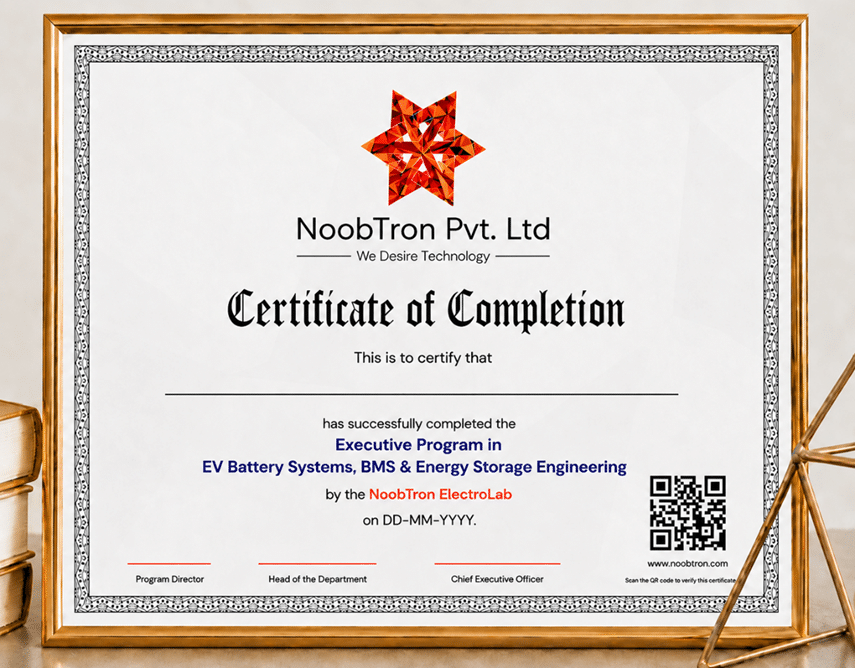
CERTIFICATE
Earn an Industry-Recognized Professional Certification
Validate your expertise in EV Battery Systems, Battery Management Systems (BMS) & Energy Storage Engineering with a prestigious certification from NoobTron ElectroLab that showcases your technical proficiency and commitment to the future of electric mobility.
WHERE THE EV REVOLUTION CREATES OPPORTUNITIES
Electric Mobility isn’t replacing industries.
It’s creating entirely new engineering careers.
As global investments in electric vehicles, battery manufacturing, Battery Management Systems (BMS), and energy storage continue to accelerate, organizations are actively seeking engineers with specialized battery engineering skills.
1300+ GWh
Projected global lithium-ion battery manufacturing capacity expansion by 2030, driven by EV and energy storage demand.
GLOBAL BATTERY INDUSTRY FORECASTS
$600+ Billion
Estimated global battery market opportunity expected over the coming decade across EVs, grid storage, and industrial applications.
ENERGY STORAGE MARKET OUTLOOK
10 Million+
Electric vehicles sold annually worldwide, driving demand for battery engineers, BMS specialists, validation engineers, and energy storage professionals.
GLOBAL EV INDUSTRY TRENDS
100+ Gigafactories
Battery manufacturing facilities planned, under construction, or operational globally, creating substantial demand for skilled battery engineering talent.
BATTERY MANUFACTURING ECOSYSTEM
This industry-focused program provides comprehensive training in EV Battery Technology, Battery Pack Design, Battery Management Systems (BMS), Thermal Management, Battery Testing & Validation, Embedded Systems, and Energy Storage Systems (ESS). The curriculum is designed to bridge the gap between academic knowledge and industry requirements.
Unlike theory-focused courses, this program emphasizes practical engineering applications, real-world battery workflows, BMS development concepts, testing methodologies, thermal management strategies, and industry-oriented projects relevant to EV and energy storage sectors.
The program duration is 4 Months, combining instructor-led sessions, practical exercises, industry case studies, projects, and career preparation activities.
Training is delivered by industry professionals, battery engineering experts, EV specialists, and experienced mentors with practical exposure to battery systems, testing, validation, and energy storage technologies.
The curriculum includes:
- Battery Fundamentals & Electrochemistry
- Lithium-Ion Cell Technologies
- Battery Pack Design & Architecture
- Battery Management Systems (BMS)
- Thermal Management Systems
- Battery Testing & Validation
- Battery Safety & Standards
- Energy Storage Systems (ESS)
- Battery Analytics & Diagnostics
- EV Battery Applications
No. The program starts with foundational concepts and gradually progresses to advanced topics, making it suitable for both beginners and experienced professionals.
Yes. The curriculum is designed around current industry practices followed by EV manufacturers, battery companies, energy storage organizations, and battery testing laboratories.
Yes. Learners gain exposure to battery engineering workflows, simulation tools, testing methodologies, communication protocols, embedded concepts, and battery analytics techniques used across the industry.
Yes. The program includes practical exercises, engineering case studies, battery design activities, testing workflows, and project-based learning experiences.
Projects may include:
- Battery Pack Design
- Battery Sizing & Configuration
- BMS Architecture Studies
- Battery Performance Analysis
- Thermal Management Studies
- Battery Testing & Validation Workflows
- Energy Storage System Applications
Yes. Learners are introduced to battery characterization, performance evaluation, validation methodologies, safety assessments, and industry testing practices.
Projects help learners build a professional portfolio demonstrating technical competency in battery systems, BMS, testing, validation, and energy storage engineering.
Yes. Participants who successfully complete the program will receive the NoobTron ElectroLab Professional Certification in EV Battery Systems, BMS & Energy Storage Engineering.
The certification validates your technical knowledge and practical understanding of battery systems, BMS engineering, testing methodologies, and energy storage technologies.
Absolutely. The certification can be added to your LinkedIn profile, resume, CV, and professional portfolio.
The certification is issued by NoobTron ElectroLab, the advanced engineering and technology training division of NoobTron.
Potential career opportunities include:
- Battery Systems Engineer
- Battery Pack Design Engineer
- Battery Test Engineer
- Battery Validation Engineer
- BMS Engineer
- EV Systems Engineer
- Energy Storage Engineer
- Battery Manufacturing Engineer
- Battery Analytics Engineer
Graduates can explore opportunities in:
- Electric Vehicle Manufacturers
- Battery Manufacturers
- Energy Storage Companies
- Battery Testing Laboratories
- Automotive OEMs
- Renewable Energy Companies
- Research & Development Organizations
Yes. With rapid growth in electric mobility, battery manufacturing, renewable energy, and energy storage deployments, demand for battery engineering professionals continues to increase globally.
Yes. Participants receive career guidance, resume support, interview preparation assistance, and industry mentoring.
The total program fee is ₹80,000.
Yes. Flexible EMI options are available to make the program accessible for students and working professionals.
Yes. The program is designed to accommodate both students and working professionals through structured learning schedules.
Yes. Participants receive access to learning materials, project resources, session recordings (where applicable), and supporting study content.
You can submit your application, complete the admission process, and secure your seat through the NoobTron ElectroLab admissions team.